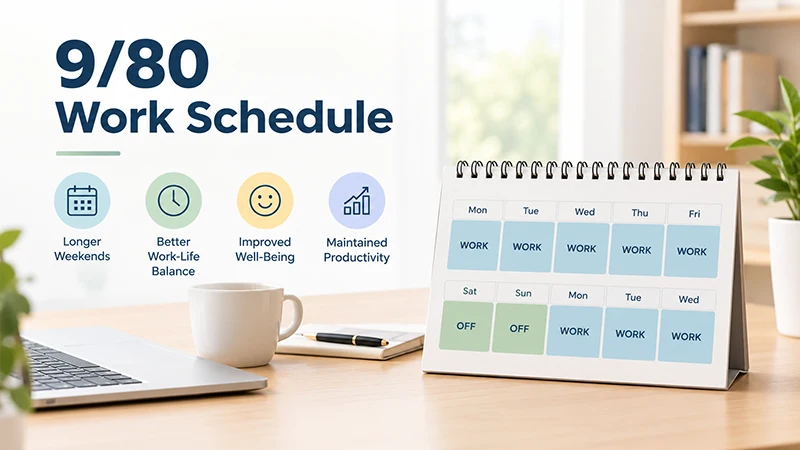
A 9/80 work schedule is a compressed work arrangement in which employees complete 80 working hours over 9 days instead of 10 working days, typically working eight 9-hour days and one 8-hour day across two weeks. Employees usually receive one additional day off every two weeks. Best suited for non-customer-centric industries, this schedule is ideal for improving work-life balance and increasing employee satisfaction.
According to Society of Human Resources’ Annual Benefits Survey, 68% of employers considered flexible schedules as “very important” or “extremely important,” highlighting the importance of alternative work arrangements. Follow along to learn more about what is the 9/80 work schedule, how it works, pros, cons, the implementation process, and whether it suits your organisation or not.
What is a 9/80 Work Schedule? How Does It Work?
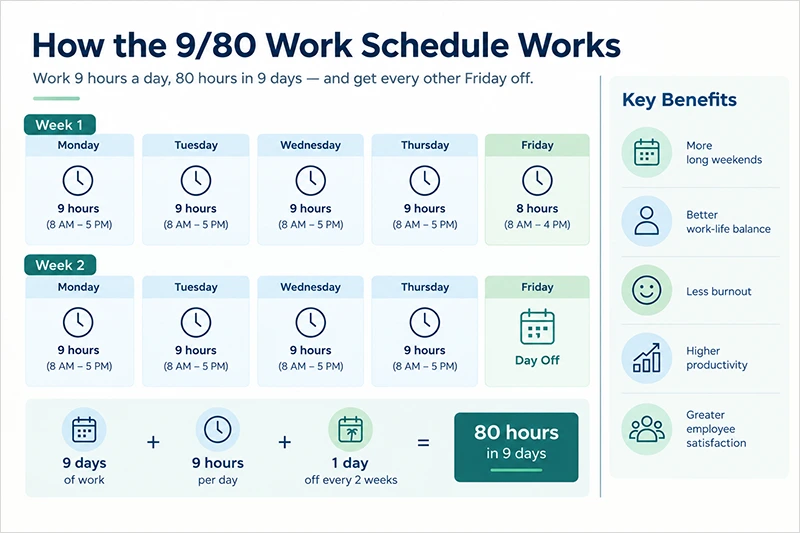
A 9/80 work schedule is a flexible work arrangement where employees work 80 hours over 9 days instead of 10 days in a typical two-week period (9-5, Monday through Friday). So, in simple terms, it is split into:
- 8 days X 9 hours: 72 hours
- 1 day X 8 hours: 8 hours
This gives a total of 80 hours worked over 9 days in two weeks, leaving the employees with an extra 1 day of holiday.
Important Note:
To ensure adherence to the Fair Labor Standards Act (FLSA) given by the US Department of Labor, an 8-hour workday (in Week 1) is split into two parts (4 hours each). So, the first four hours count towards week 1, and the remaining 4 are counted towards week 2.
This prevents accidental overtime pay and payroll deductions, and adheres to the “40 working hours per week” rule laid out by FLSA.
How Does a 9/80 Schedule Work?
| Week | Working Days | Hours |
| Week 1 | 5 days | 44 hours |
| Week 2 | 4 days | 36 hours |
| Total | 9 days | 80 hours |
Bifurcating this further:
| Monday | Tuesday | Wednesday | Thursday | Friday | Total Hours | |
| Week 1 | 9 Hours | 9 Hours | 9 Hours | 9 Hours | 8 Hours | 44 Hours |
| Week 2 | 9 Hours | 9 Hours | 9 Hours | 9 Hours | Off Day | 36 Hours |
The primary benefit of this flexible work arrangement is that employees get an extra day off every two weeks without reducing the total working hours or regular pay.
Additional Fact:
This structure is also referred to as “Compressed Work Schedule (CWD)” which enables full-time employees to complete the basic 80-hour biweekly work requirement in less than 10 workdays, as defined by US General Service Administration.
What is the Difference Between Traditional 9-to-5 and 9/80 Schedule?
The primary difference between a typical 9-to-5 and 9/80 work schedule is that while 9-to-5 follows a standard 8-hour workday with fixed weekends off, a 9/80 schedule enables employees to work 80 hours over 9 days instead of 10 days, while allowing a longer weekend every other week.
Here are the points of difference between the traditional 9-to-5 and 9/80 work schedule:
| S No. | Points of Differences | 9 to 5 Schedule | 9/80 Work Schedule |
| 1. | Working Hours | Typically 8 hours daily | 9 hours daily + one 8-hour day |
| 2. | Workdays Per Week | 5 workdays | 5 days one week and 4 days the next week |
| 3. | Days Off | Weekends (Generally Saturday and Sunday) | Weekends + 1 additional day off every alternate week. |
| 4. | Daily Workload | Shorter day compared to 9/80 schedule | Longer shift |
| 5. | Best Suited For | Hospitality, healthcare, banking, education, corporate, and IT sectors. | Project-based companies, corporates, engineering, and research-based industries |
Also Read: Employee Development Plan: 5 Examples, Template & How-To Guide
What are the Pros and Cons of a 9/80 Work Schedule?
While a 9/80 schedule offers greater flexibility, better work-life balance, less commute strain, and reduced absenteeism, it may not be ideal for every organisation, such as healthcare and hospitality. It may lead to fatigue and complex HR tracking.
Here are the pros and cons of the 9X80 schedule:
| Pros and Cons of 9/80 Work Schedule | ||
|---|---|---|
| S No. | Pros | Cons |
| 1. | It supports a better work-life balance by guaranteeing an extra day off every alternate week, offering more time for family, hobbies, and personal responsibilities. | Stretching a standard 8-hour shift to 9 hours may lead to fatigue, especially for working parents, caregivers, and employees with long commutes. |
| 2. | Greater flexibility increases job satisfaction, retention, and attracts top talent. | A 9-hour shift creates unintended overtime, which may lead to a productivity dip in the longer run. It risks the overall effectiveness. |
| 3. | It reduces absenteeism by providing 2 extra off days in a month, enabling employees to manage personal and professional responsibilities. | It requires policy alterations when policies are based on a standard 8-hour shift. |
| 4. | Longer, uninterrupted work periods support deeper concentration, enabling employees to focus on complex tasks. | Managing public holidays, sick leave, and midweek absence complicates HR tracking, calculation, and holiday entitlements. |
| 5. | Having an extra day off coming up boosts employee morale, leading to better productivity. | Longer work hours may fall outside customers’ and partners’ active hours, which reduces productivity and creates business gaps. |
| 6. | An extra day off means no travel and no idling in traffic, reducing the commute strain on employees. | |
Alternative and Compressed Work Schedule Similar to 9/80 That Every Manager Must Know
The 4/10 work schedule and 3/12 schedule (rotating shifts, generally for nursing, manufacturing, and emergency industries) are the most common types of compressed work schedules.
Here’s what you need to know about them:
1. 4/10 Work Schedule
A 4/10 work schedule is an arrangement in which employees work four days per week for 10 hours per day, completing a total of 40 hours per week. Instead of working five days for 8 hours per day, employees get three days off each week, including the weekend.
Here’s how a 4/10 schedule works:
| Monday | Tuesday | Wednesday | Thursday | Friday | Total Hours | |
| Week 1 | 10 Hours | 10 Hours | 10 Hours | 10 Hours | Off Day | 40 Hours |
| Week 2 | 10 Hours | 10 Hours | 10 Hours | 10 Hours | Off Day | 40 Hours |
The same follows for the rest of the weeks. However, the specific working days may vary depending on the employer’s working requirements.
2. 3/12 Work Schedule
Under a 3/12 work arrangement, employees work 3 days per week for 12 hours per day and take the remaining four days off. Generally used in nursing, emergency, healthcare, and manufacturing industries, employers use rotating shifts to maintain continuous business operations.
Here’s how a 3/12 schedule works:
| Monday | Tuesday | Wednesday | Thursday | Friday | Total Hours | |
| Week 1 | 12 Hours | 12 Hours | 12 Hours | Off Day | Off Day | 36 Hours |
| Week 2 | 12 Hours | 12 Hours | 12 Hours | Off Day | Off Day | 36 Hours |
*This is just an illustrative schedule. Actual nursing or manufacturing industry rosters vary accordingly.
Important Note:
Other work schedules, such as:
- 2-2-3 (Pitman Schedule)
- Dupont
- Rotating Shifts
These schedules are commonly used by nursing, manufacturing, emergency, and law enforcement industries. They often involve 12-hour day or night shifts, followed by a scheduled day off, to maintain continuous staffing.
How to Implement a 9/80 Work Schedule? Step-By-Step Guide

Implementing a 9/80 work schedule requires an organisation to properly analyse its workload, customer base, employee feedback, and payroll readiness. It needs to be properly communicated, implemented, and managed by regularly monitoring productivity, attendance, and employee engagement and satisfaction.
Here’s a step-by-step guide on how to implement a 9/80 work schedule:
1. Planning Phase
During the planning phase, assess:
- Company’s Workload
- Client Service Hours
- Shift Timings
- Payroll Rules
- Calculation of Sick Leave and Holidays
Most importantly, ensure that your working hours align with customers or business partners and comply with labour laws, including overtime regulations.
2. Communication
Ensure that the new working schedule is clearly communicated to the employees and that robust feedback is taken and acted upon.
Here’s what you need to do:
- Communicate the new working schedule.
- Set clear expectations
- Gather employee feedback
- Address Employee Concern
3. Implementation
Begin with pilot implementation or a trial before actually introducing the arrangement. Gather the feedback and analyse its effectiveness. Analyse your payroll monitoring and readiness, and whether your payroll automation is able to manage compressed hours and overtime calculations.
Once everything is ready, implement the arrangement and provide necessary support to the employees required to adhere to the new working schedule.
4. Management
Continuously monitor productivity, attendance, employee satisfaction, and customer coverage. Review feedback regularly and adjust the schedule to maintain operational efficiency.
Is a 9/80 Work Schedule Right For Your Business? Important Factors to Consider
A 9/80 is a right fit for your business only if your job and industry type are NOT customer-centric, meaning it does not require face-to-face interaction. Common examples include IT, marketing, consulting, finance, etc.
Important factors to consider before opting for a 9/80 schedule are staff gaps and operational needs, employee feedback, payroll readiness, and the customer’s or business partner’s availability.
1. Job Type and Industry Fit
A 9/80 schedule is best suited for industries with independent tasks and where daily real-time customer service and interaction are not mandatory. However, it does NOT work for customer-centric jobs, such as hospitality, healthcare, and front desk, which require regular customer interaction.
Industries where a 9X80 schedule is suitable:
- Information Technology
- Marketing and Advertising
- Government and Administrative Services
- Engineering and Consulting
- Finance
Industries where a 9X80 schedule may NOT be suitable:
- Healthcare
- Hospitality
- Retail
- Manufacturing
- Customer Support and Call Centers
2. Staff Gaps and Operational Needs
A 9/80 work schedule may NOT be ideal for smaller organisations because they might fail to cover the staff gaps. Hence, before opting for a 9/80 work schedule, consider it suitable only when:
- Businesses can split the shifts and assign different days off to maintain adequate staffing.
- Project-based teams are able to schedule meetings and collaborate around employees’ availability.
- Organisations have a predictable customer demand, especially during employees’ active hours.
Consider if UNSUITABLE if:
- The organisation has a small team and limited backup staff to cover absences.
- It is a customer-centric organisation where customers may experience service gaps due to staff unavailability.
- The organisation seeks real-time coordination.
What to Evaluate?
Before opting for a 9/80 work schedule, evaluate:
- Customer Service Hours
- Minimum Staffing Requirements
- Peak Business Period
- Backup Arrangement
3. Employee Feedback and Work-Life Balance
Seek employee feedback before instantly changing the work schedule. If staff don’t agree, it may lower morale and productivity.
It is suitable when employees:
- Value longer weekends and work-life balance
- Feel commute strain
- Prefer long, uninterrupted working periods (generally project-based teams)
Avoid this arrangement if:
- Employees find longer working days difficult to manage.
- Workers have a long commute, which can increase fatigue and reduce free time on workdays.
- Employees prefer a standard 8-hour predictable schedule.
4. Payroll and Compliance Readiness
A 9/80 schedule requires splitting the 8-hour day into half-days across two weeks (for example, four hours count towards week 1 and the next four hours are counted towards week 2) to keep each work week at a standard of 40 hours.
Before opting for a 9/80 schedule, evaluate whether your payroll system can handle:
- Overtime calculations
- Attendance tracking
- Paid leaves
- Public holidays
- Division of working hours across the workweeks
5. Customer and Business Partner Availability
A 9/80 schedule may affect how employees coordinate with customers, clients, suppliers, and external partners who follow conventional working hours. Customers and business partners may be inactive when your organisation is active, and hence, it may affect the overall effectiveness of working longer hours.
It may not be suitable for businesses that:
- Depend on immediate customer response.
- Work with suppliers and external partners with conventional working schedules.
- Require daily client meetings.
Important Note:
Compare employee working hours with customer or business partner operating hours, service schedules, and meeting requirements.
Final Thoughts
To sum up, a 9/80 work schedule is a great working arrangement when your employees value longer weekends, better work-life balance, less commute strain, and longer, uninterrupted working periods.
However, it might NOT be the best option if your organisation’s services are customer-centric and employees find longer hours difficult to manage due to a productivity dip. Hence, before making a final decision, evaluate the job type, industry fit, payroll readiness, employee feedback, and staff backup arrangement.
Frequently Asked Questions (FAQs)
1. What is a 9/80 schedule?
Ans: A 9/80 work schedule is a flexible work arrangement where employees work 80 hours over 9 days instead of 10 days in a typical two-week period (9-5, Monday through Friday). The main benefit of this workday arrangement is that it gives employees an extra day off every alternate week.
2. What is the healthiest shift work schedule?
Ans: A standard 9-to-5 work schedule is generally considered healthy, wherein employees work 5 days for 8 hours per day. The main benefit of this work arrangement is that it ensures a short shift (8 hours), a predictable schedule, and two days off, ideal for maintaining work-life balance.
3. What are the benefits of a 9/80 work schedule?
Ans: Better work-life balance, increased employee satisfaction and retention, a flexible work schedule, less commute strain, and reduced absenteeism are the main benefits of a 9/80 work schedule.
4. How to know whether 9/80 is suitable for an organisation or not?
Ans: Evaluate your job type, industry fit, backup staff arrangement, employee feedback, and payroll readiness to understand the 9/80 schedule’s suitability. It is best suited for large organisations with backup staff and less customer-centric jobs, such as marketing, research, etc.
5. How is payroll processed in a 9/80 work schedule?
Ans: Payroll processing requires splitting one 8-hour workday into 4-hour shifts to prevent overtime according to labor laws.