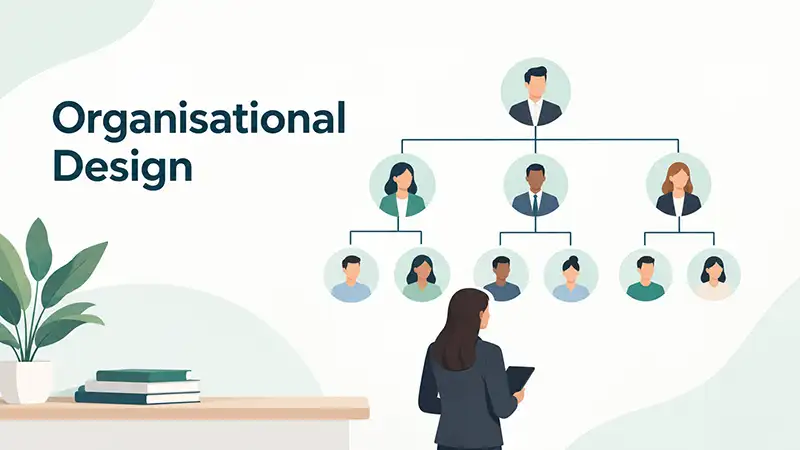
An organizational design is a strategy that outlines an organisation’s structure, hierarchy, processes, workflow, and reporting relationships. A suitable organizational design optimizes costs, improves decision-making, boosts innovation, and enhances job satisfaction. Commonly identified as functional, divisional, matrix, network, flat, hierarchical, and more, it helps build a key approach for adaptability.
Deloitte shows that while 92% of leaders prioritize organizational redesign, only 11% feel confident in their ability to execute it successfully. It requires the right strategy, which includes understanding long-term goals and workflows, analysing and selecting the right model, defining roles and KPIs, pilot testing, and successful implementation, with continuous review and feedback.
Follow along to learn more about various organizational designs, their benefits, elements, how to build one, and unique organization designs.
What is Organizational Design? What Are Its Benefits?
According to Forbes, an organisational design involves detailed analysis and editing of structures, roles, and processes to realise an organisation’s strategy and goals. It defines the size and shape, and how the firm will function.
In simple words, organisational design is a strategy of shaping an organisation’s structure, processes, workflows, and roles to align with the business objectives. It provides clarity by clearly defining reporting relationships, roles, responsibilities, authority, and setting expectations.
How Does an Organisational Design Benefit the Business?
Here are the benefits of an organizational design:
- Increase Productivity: By clearly labeling the roles, responsibilities, workflows, and reporting relationships, it streamlines job roles and task expertise, automatically enhancing productivity.
- Role Clarity and Accountability: By defining clear reporting lines, an organizational design ensures that each professional knows who is responsible for what, keeping the teams accountable.
- Operational Efficiency: Organisational design fosters seamless communication, allows faster decision-making, and significantly reduces the chances of duplication and errors.
- High Job Satisfaction: When employees are given clear directions, balanced workloads, and future positions, it enhances employee engagement and job satisfaction.
Types of Organizational Structure: Functional, Matrix, Divisional, Network, and More
Functional, divisional, matrix, network, flat organisational, hierarchical, and decentralised models are some of the most commonly known types of organizational structures.
Here’s what you need to know about various types of organizational structure:
1. Functional Organizational Design
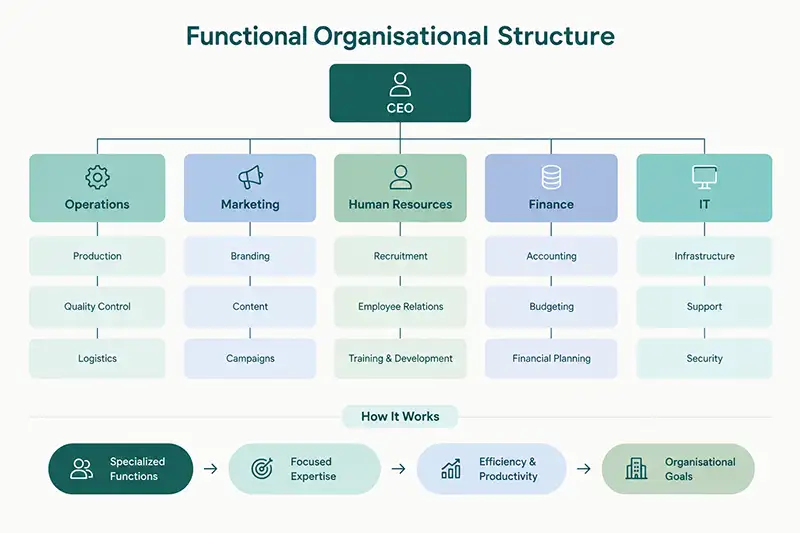
Best for large organisations, a functional organizational design groups employees by specialised functions or areas of expertise, such as marketing, human resources, finance, IT, and more. It follows a top-down management hierarchy, where each department has a manager overseeing the department’s operations, and workers are organised by their skills and functions.
Advantages:
- Enhances productivity as employees are focused on their expertise.
- Clear accountability and defined roles and responsibilities reduce overlap and confusion.
- Promotes specialisation and simplified management by allowing functional leaders to focus on performance and development of their respective departments.
- A straightforward chain of command and fast decision-making.
Disadvantages:
- May lead to silos and reduced communication between departments.
- It may offer limited business-wide perspective as employees are focused on functional goals, rather than broader business outcomes.
- Slower cross-functional decisions.
Did You Know?
Functional organisational design is one of the most common types of business structure, and according to McKinsey, 89% of organizations still utilize traditional hierarchical or functional structures as their primary design.
2. Divisional Organisational Design
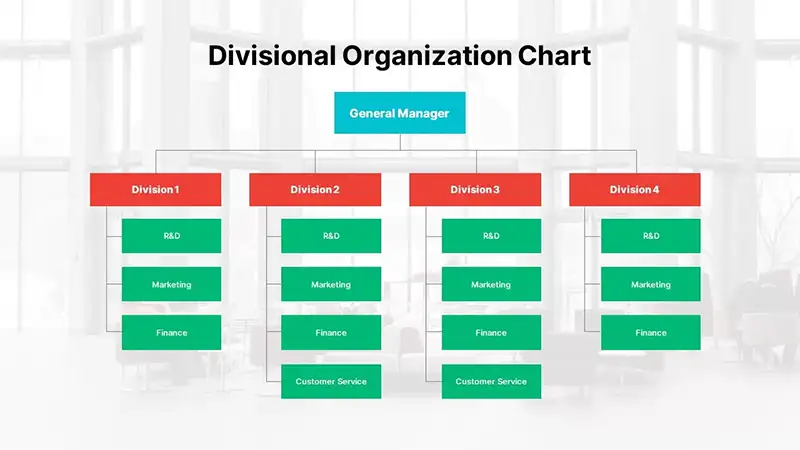
Ideal for large companies with extended operations, a divisional organisational structure divides the organisation based on specific business dimensions, such as product, geography, etc. It features top-down control, and each division functions as an individual unit with full autonomy to make its decisions and run daily operations.
For instance, Samsung organizes separate divisions based on their product line, such as mobiles, television, and home appliances.
Advantages:
- Flexible and fast decision-making because each division is autonomous.
- Allows divisions to cater to the specific needs of the consumer market, product, or geographical location.
- Quick response to changes in markets and supply chains.
- Clear performance metrics, as each division is assessed against its own revenue, costs, and profit-and-loss, which also helps identify bottlenecks regarding the performance of a particular product or geographical location.
Disadvantages:
- Each division may need its own marketing, IT, HR, etc which leads to resource duplication.
- Unhealthy competition may lead divisions to prioritize their individual objectives over organisation-wide goals.
- Making company-wide changes can be time-consuming and may lack communication and coordination.
3. Matrix Organizational Structure
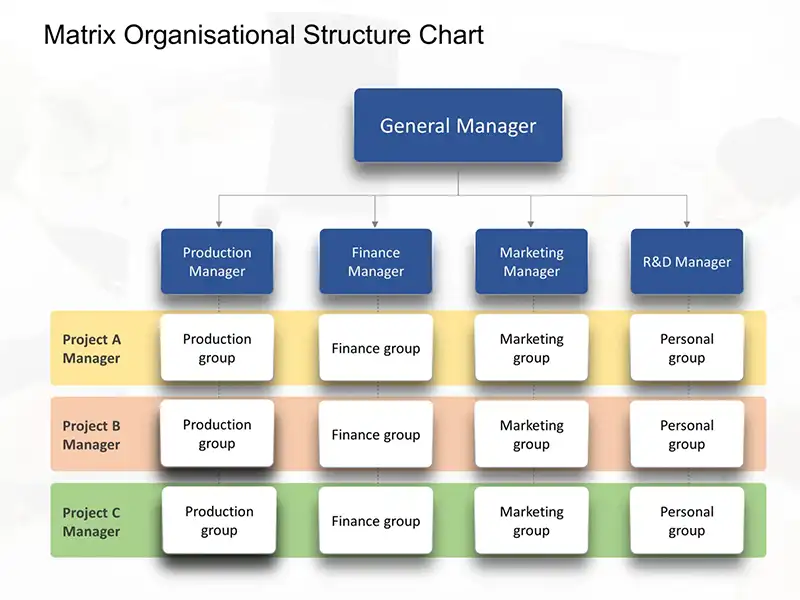
A combination of functional and divisional structure, matrix organisational design creates a grid-like framework, where employees report to multiple managers- functional managers and a product/project manager.
For Example: In a marketing company, a graphic designer may report to their creative director (functional manager) while also working with a marketing manager (product/project manager) to understand the creative standards for an upcoming advertising campaign.
Advantages:
- Cross-functional collaboration allows departments to work together on projects.
- Allows employees to work on diverse projects, boosting their morale, motivation, and professional development.
- Ensures better resource allocation and avoids duplication of efforts by allowing resources to be shifted between projects.
- Balanced functioning: maintaining the functional standards while also giving attention to individual projects.
Disadvantages:
- Receiving information and reporting to two managers may create conflicting priorities.
- Power struggles between functional managers and Project Managers may reduce quality of work.
- Successful execution requires strong communication and coordination.
4. Network Organizational Design Structure
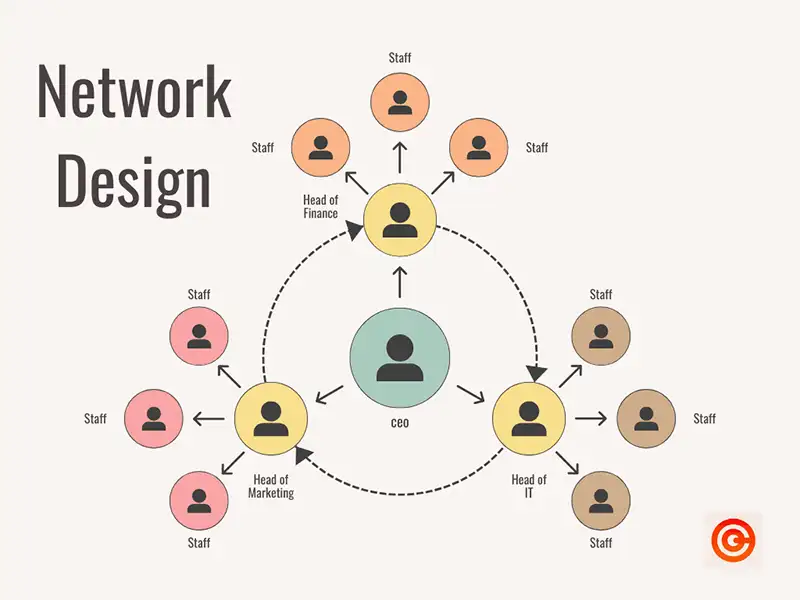
A network organizational design structure requires the partnership of both internal and external partners, such as suppliers, partners, or contractors, which are generally outsourced for non-core activities. The central organisation functions as a coordinating unit, and this structure allows it to focus on core business activities while using the expertise of external partners.
Advantages:
- Ensures greater flexibility by allowing different units autonomy over their operations.
- Outsourcing is cost-effective, and the organisation can draw expertise using both internal and external partners.
- Easy adaptability and a high focus on core business objectives.
- Collaboration between teams and departments.
Disadvantages:
- Lack of clear communication lines may lead to confusion and chaos.
- Limited control over autonomous units.
- Heavy reliance on external partners can create operational barriers, and quality control can become difficult.
5. Flat Organizational Design Structure
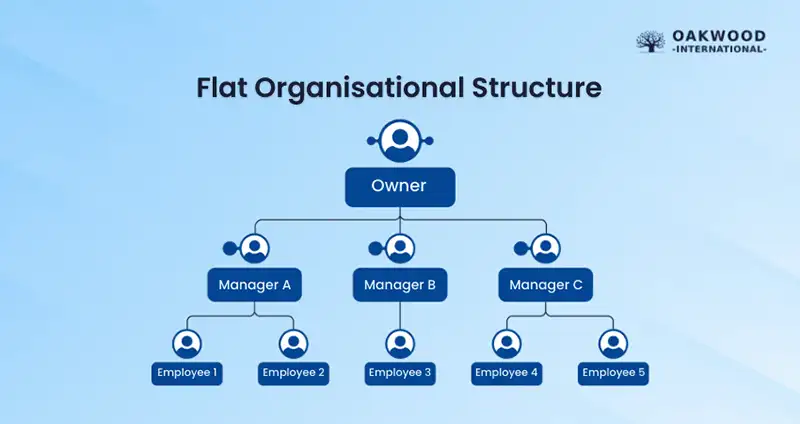
A flat organisational design, also known as a horizontal structure, features minimal or no hierarchical layers between employees and senior leadership.
Instead of having multiple middle managers, employees get direct access to decision-makers, keeping the top-level executives in close contact with employees. It ensures open communication and flexibility, making it ideal for SMBs.
Advantages:
- More flexibility and faster decision-making.
- Straightforward chain of command and greater autonomy.
- Fewer managerial levels significantly reduce management costs.
- Promotes open communication and collaboration, strengthening team unity.
Disadvantages:
- Few advancement opportunities as there are few managerial positions.
- Scaling can become difficult as employee numbers and operational complexity grow.
- Excessive responsibility burden on top-level executives and chances of interpersonal conflicts.
6. Hierarchical Organisational Design
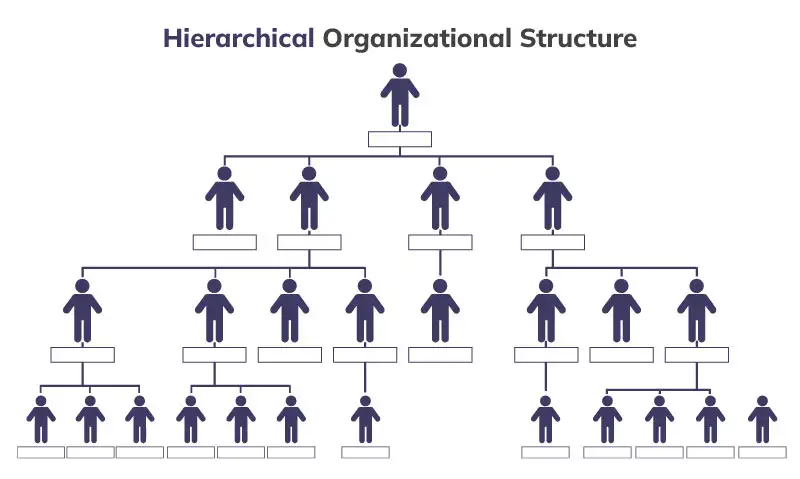
A hierarchical structure follows a strict line of command and multiple levels of authority, with senior leaders at the top and employees at progressively lower levels. Each level in the hierarchy has different levels of responsibility, and it is responsible for reporting to the level above it.
For Example: In an organisation, employees report to the team leaders, who will then report to the department managers, who will then report to the senior executives. Hence, it moves through clearly defined management levels.
Advantages:
- Clear chain of command, roles, and reporting relationships.
- Higher career advancement opportunities.
- Defined authority and accountability as to who is responsible for what.
- Consistent decision-making and processes.
Disadvantages:
- Significantly slower decision-making as it passes through multiple levels of management.
- Communication barriers between multiple levels.
- Limited employee autonomy and slow adaptability.
7. Decentralised Organisational Structure
A decentralised organisational structure distributes power across multiple teams, departments, and levels, instead of power being concentrated in the hands of upper management.
While lower-level managers and employees focus on day-to-day operations, the higher management focuses on strategic planning, affecting the broader business operations.
Advantages:
- Higher flexibility, employee development, and autonomy in functioning.
- Faster decision-making process.
- Greater employee engagement, empowerment, and job satisfaction.
- Encourages innovation and adaptability.
Disadvantages:
- It can create confusion for small businesses and startups.
- Decisions may be inconsistent across teams, which may hinder the unity of the organisation.
- Potential for redundancies.
How to Design an Organizational Structure? Step-By-Step Process
Designing an organizational structure requires a business to identify its long-term goals, analysing and selecting the right model, defining roles and KPIs, pilot testing, and successful implementation, with continuous review and feedback.
Step 1: Identify the Long-Term Business Goals
Here’s a checklist of what you need to do:
- Identify the long-term objectives.
- What’s the growth strategy, anticipated future market positioning, and the efficiency it aims to achieve?
- Research the structure that aligns with the vision.
Step 2: Understand the Organisation’s Workflow
- List the departments your organisation will require (marketing, IT, etc.)
- Analyse how you want the processes to flow (ex., top-down approach)
Step 3: Analyse the Various Organization Designs
- Research the various organisation designs (functional, network, matrix, etc.).
- List the ones that you believe will suit the organisation.
- Identify pros and cons of each in relation to the specific needs.
Step 4: Establish Roles and Responsibilities
- Define the roles, skills, and responsibilities. Prepare a job description for each role.
- Establish a chain of command, reporting relationships, and hierarchy of authority.
- Identify collaboration tools.
- Establish communication pathways for the cross-functional teams.
Step 5: Define KPIs
- Set KPIs and other performance metrics to review employees’ performance and productivity.
- Establish a system for regular feedback, review, and issue redressal.
Step 6: Pilot Test the Structure
- Before final implementation, pilot-test the structure and list the bottlenecks.
- Properly communicate and guide the transition to employees (implement training sessions, if necessary).
Step 7: Refine and Implement
- After refining, implement the structure and review it periodically for maintenance.
- Seek regular feedback and ensure proper redressal.
What Are The Elements of an Organizational Design?
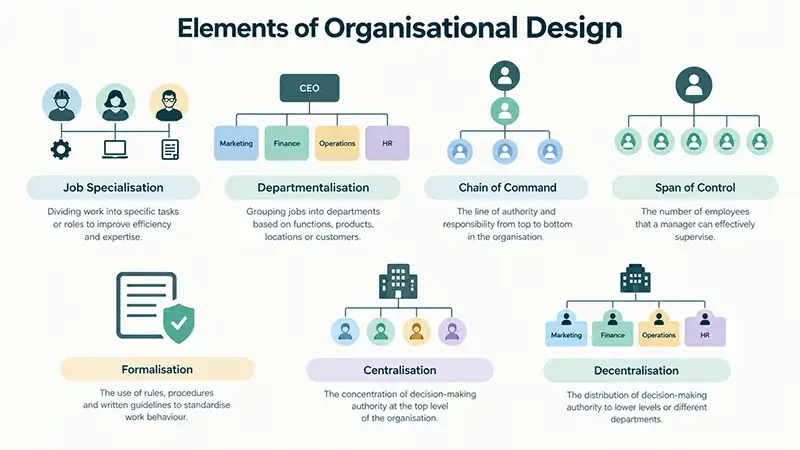
Job specialisation, departmentalisation, chain of command, span of control, formalisation, centralisation, and decentralisation are the key elements of an organization design.
1. Work Specialisation
Work specialisation ensures that a specific task is assigned to each working professional who is best suited for the particular role in an organisation.
Commonly observed in industries such as finance, tech, and manufacturing where roles are clearly defined, work specialisation helps employees develop expertise in a particular role, leading to enhanced productivity, efficiency, and effectiveness.
For example, professionals working in a warehouse will perform distinct tasks, such as:
- Order Picking
- Packaging
- Inventory Management
- Delivery
| Advantages | Disadvantages |
|
|
2. Departmentalisation
Departmentalisation means dividing the organisation into different units or departments, based on certain factors, such as product, geography, function, or more. It groups the employees with the same skill sets and knowledge into one department/unit.
For Example: An organisation may divide its business into small units, based on functions, such as:
- Marketing
- Human Resource
- IT
- Finance
| Advantages | Disadvantages |
|
|
3. Centralisation and Decentralisation
Centralisation and decentralisation clearly define the authority, or who will retain the decision-making power.
In centralisation, the power lies in the hands of top management and executives, responsible for final decision-making, while decentralisation requires the transfer of power to smaller units and authorities.
4. Chain of Command
A chain of command establishes the hierarchy of authority and reporting relationships in an organisation. It clearly defines who reports to whom, who is responsible for what, and how the decisions flow from top to bottom.
For Example: A large organisation may have a hierarchy of authority, such as:
- Board of Directors
- CEO
- Vice Presidents
- Managers
- Team Leaders
- Employees
5. Span of Control
The span of control defines the number of employees a manager can effectively manage. A wider span enables wider organisational efficiency.
For Example: An organisation has 200 employees and 20 managers, so:
- The ratio becomes 10:1
- Meaning, 10 employees are handled by 1 manager
6. Formalisation
Formalisation means the workplace rules, regulations, and procedures the employees must adhere to. High formalisation means strict rules and procedures, whereas low formalisation means fewer workplace rules and regulations.
Which Organization Design is Suitable for Your Business?
Although the right choice depends on certain factors, such as businesses’ size, workflow complexity, and more, here’s a general list of organisation design and their suitability:
| S No. | Organizational Design | Industries They Are Suitable For |
| 1. | Functional |
|
| 2. | Divisional |
|
| 3. | Matrix |
|
| 4. | Flat Organisational |
|
| 5. | Network |
|
Also Read: 90 Questions to Ask in An Interview – Categorised List (2026)
Organisations With Unique and Successful Organizational Design (Real-Life Examples)
Amazon, Spotify, and Zappos are known for their unique and successful organisational designs.
1. Holacracy
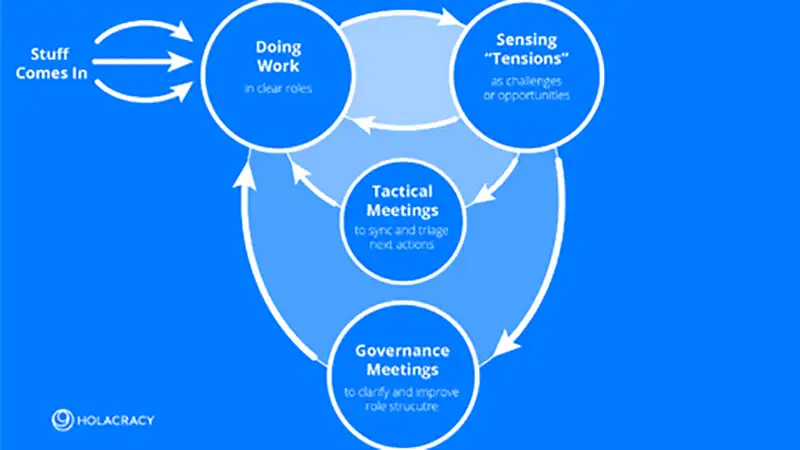
Zappos follows Holacracy, a management style where power is nested within several self-organised teams, also called circles, rather than being concentrated in the hands of upper management levels.
2. Squad Model
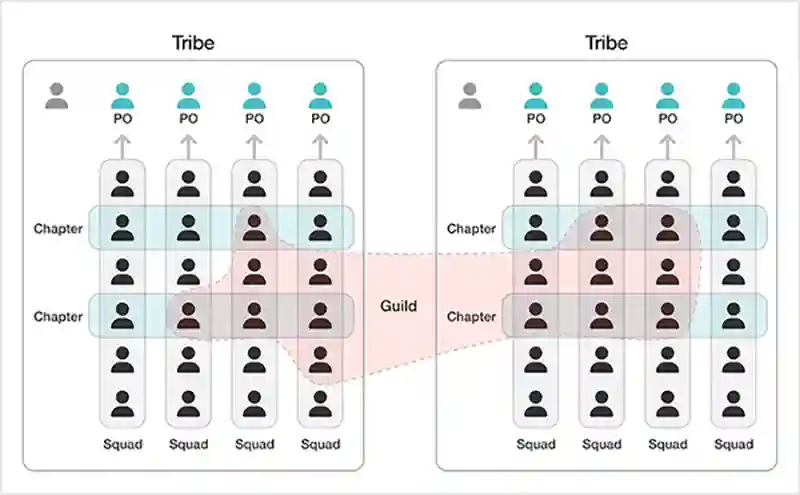
Spotify follows the squad model. Squads, also known as tribes, are small, cross-functional, and autonomous teams (typically 6-12 people), operating like a startup.
3. Two-Pizza Teams
Amazon follows the two-pizza model, which means no team should be big enough that it would take more than two pizzas to feed them. It ensures agility and reduces communication overhead.
Final Thoughts
To sum up, a clutter-free and well-made organisational design is crucial to sustain the business and support its long-term visions. From multiple options, such as functional, divisional, matrix, network, flat, hierarchical, and more, the right choice depends on your business size, goals, complexity, and workflow.
Frequently Asked Questions (FAQs)
1. What is meant by organizational design?
Ans: An organisational design is a pre-defined structure that arranges an organisation’s roles, responsibilities, teams, lines of communication, decision-making authority, and workflows to achieve its business goals efficiently.
2. What are the different types of organisational designs?
Ans: Functional, divisional, network, matrix, flat organisational, decentralised, hierarchical, and team-based are some common types of organizational structure.
3. Which organisational design is suitable for small businesses and startups?
Ans: Flat, functional, or team-based organisational designs are best for small businesses and startups as they offer a clear line of communication, flexible decision-making, and clear responsibilities and authority with fewer management layers.
4. What are the elements of organizational design?
Ans: Job specialisation, departmentalisation, chain of command, span of control, formalisation, centralisation, and decentralisation are the key elements of an organization design.