
Compensating employees is what keeps them motivated and makes them use their full potential.
But how to calculate these compensations?
That’s where enterprise compensation management comes into play.
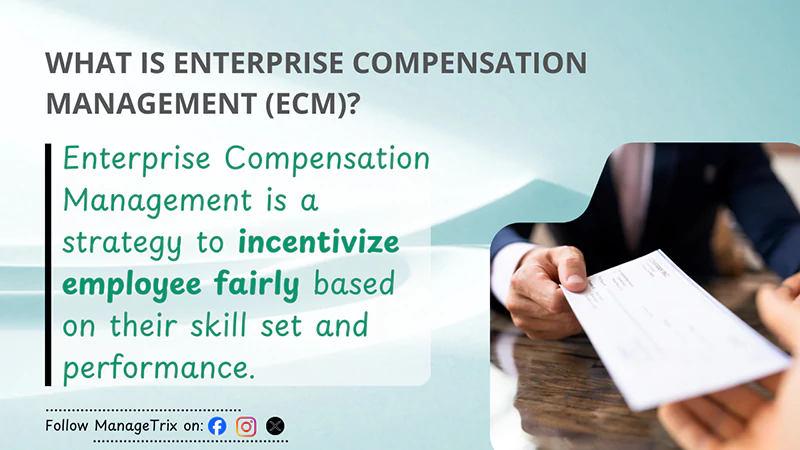
Enterprise Compensation Management is a strategy to incentivize employee fairly based on their skill set and performance. However, several other factors also influence it.
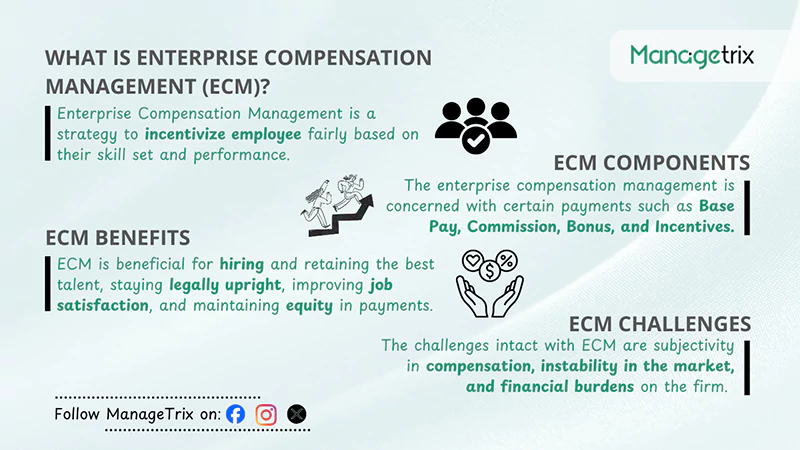
This article aims to tell you everything about enterprise compensation management (ECM), along with other information, such as its main components, benefits, challenges, and the tools and technologies that are used in ECM. So, get ready to learn everything related to enterprise compensation management.
What is Enterprise Compensation Management?
Enterprise compensation management is a simple and structured process that assists organizations in planning and managing their employee pay. The process of compensation management includes everything from the base salaries of employees and bonuses to benefits and long-term rewards.
The main goal of this process is to ensure that compensation supports the overall business objectives of the company. ECM matches pay strategies with its business goals in the following ways:
- Offering competitive and fair salaries.
- Controlling workforce costs.
- Connecting employee rewards to outcomes and performances
Understanding the main principles sets the foundation for the core concepts of enterprise compensation management.
What are the Core Components of Enterprise Compensation Management?
It is essential for organizations to know that enterprise compensation management relies on a number of key components to ensure the creation of a fair, competitive, and effective pay system. Each and every element is vital in aligning compensation management with the goals of the organization and the expectations of the employee.
Salary Structures and Pay Bands
One of the most important components of ECM is salary structures and pay bands. Salary structures offer a clear pay range for different roles, which ensures fairness and consistency across the organization. Pay bands, on the other hand, assist in the management of compensation equity and market competitiveness.
They provide a transparent structure that is useful in hiring, promotions, and salary adjustments. Pay bands encompass different variations based on job level, location, and department to highlight market differences.
Performance Metrics and Pay-for-Performance
Attaching compensation to performance motivates employees to meet their goals and even exceed them to drive the business towards success. Having clear metrics ensures that everyone is accountable and high achievers are rewarded.
Organizations create measurable targets that are linked to individuals, teams, and even company performance and these are usually assessed through performance reviews. Additionally, pay-for-performance models include bonuses, merit increases, and even profit sharing to encourage employees.
Incentive Programs
Incentives go above and beyond pay to reward those who have achieved certain achievements that support the objectives of the company. These incentive programs boost morale of the employees and encourage ongoing engagement.
These incentive programs include bonuses, commissions, stock options, and even non-monetary rewards such as extra vacation days. Properly designed incentives match employee actions with the desired outcomes that reinforce company values.
Equity Compensation
Another important component of ECM is equity compensation, which allows employees to own a specific portion of the company through stock options and grants. This type of compensation is quite common in new startups and tech companies.
Equity compensation aligns the interests of employees with the long-term success of the company, which encourages them to stay with the company and contribute to its long-term growth.
Benefits and Perks
Compensation planning is not restricted to cash payments, as employee benefits, such as health insurance, retirement plans, paid time off, wellness programs, and flexible work arrangements, are essential for the overall compensation package of the company. These non-monetary rewards have a significant role in employee satisfaction and well-being.
Compensation Analytics and Data-Driven Decisions
Using compensation analytics provides organizations with insights into pay trends, equity gaps, and budget impacts. This enables smarter compensation strategies, as data helps eradicate guesswork and bias.
Numerous analytics tools are used to track compensation metrics and benchmark against industry standards. Additionally, data-driven decisions enhance transparency and establish competitive, equitable pay practices.
Budgeting and Financial Planning
Having a budgeting and financial planning process ensures compensation plans are sustainable and match the financial goals of the organization. This balances rewarding employees with management costs.
Compensation budgeting distributes funds across different departments and pay categories based on priorities set by the company, whereas regular financial reviews allow adjustments to keep compensation competitive and within budget.
Communication and Transparency
Unlike what people think, one of the most important components of ECM is communication and transparency, as clear communication around compensation policies establishes trust and understanding among employees.
On the other hand, transparency eradicates uncertainty and enhances engagement. Sharing how pay decisions are made assures employees that the system is entirely fair, and open dialogue motivates feedback and gives way to timely resolution of compensation concerns.
Compliance and Regulatory Adherence
It is essential for every organization to adhere to labour laws and regulations, as this not only protects employees but also the organization and ensures fair treatment of employees. Compliance reduces any legal risk and promotes ethical practices.
Practices such as regular audits and policy reviews are used to keep compensation matched with current regulations. Training and documents also support the consistent application of pay policies and equal opportunity.
Pay Equity and Internal Fairness
Pay equity and fairness work as the foundational pillars that govern how any organization attracts, retains, and even motivates its workforce. While a pay structure design highlights salary bands, enterprise compensation management makes sure that these bands are applied equitably, transparently, and consistently across thousands of employees.
What Types of Compensation Does Enterprise Compensation Management Include?
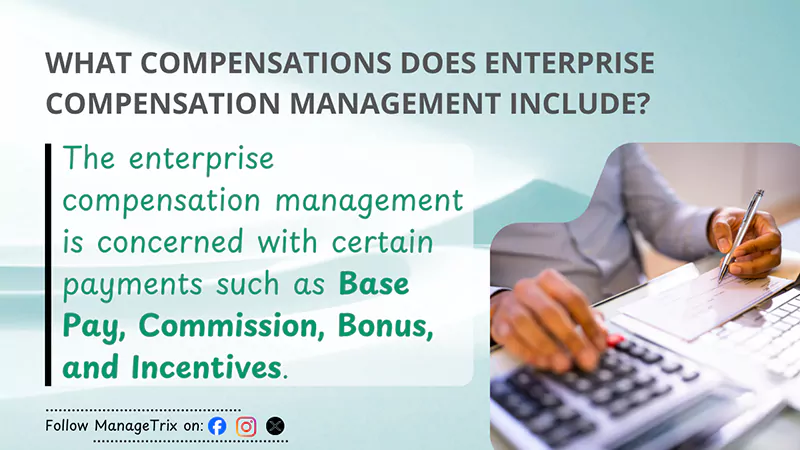
Essential and effective enterprise compensation management includes a number of different types of compensation, and each and every one of them is designed to meet organized organizations’ goals and employee needs. Understanding these different types from base pay to broader remuneration, is quite important for creating a comprehensive compensation package.
| Type | Description | Example |
| Base Salary | This refers to the fixed pay based on the role and the experience of the employee, and it provides financial stability. | Annual salary of $80,000 |
| Bonuses | These are rewards that are tied to the performance of employees, which means that it motivates employees and recognizes their efforts. | Year-end performance bonus |
| Commission | Commission refers to the variable pay based on sales performed by any employee. The main motive of commissions is to drive revenue generation. | 5% of closed deals |
| Benefits Packages | Employee benefits include all non-monetary benefits, such as insurance and PTO, which make the job more satisfactory for employees. | Health insurance, retirement plan, paid time off |
| Stock Options and Equity Compensation | These are long-term rewards that line up with the growth of the company and promote loyalty. | Stock options, restricted stock units (RSUs) |
| Incentives | Incentives also refer to the additional compensation that is provided to the employees other than the base salary for their exceptional performance. | Profit-sharing awards, retention incentives |
| Perks and Non-Monetary Rewards | All the non-monetary rewards provided to employees fall under this category, which motivates employees to perform better. | Flexible hours, learning budget |
Having a clear view of the different types of compensation, organizations can easily plan their budget in a strategic manner to support competitive and sustainable pay programs. For a deeper look at how pay and benefits differ, see compensation and benefits in HR.
What is the Role of Budgeting in Enterprise Compensation Management?
Compensation budgeting also plays an essential role in making these compensation programs effective and sustainable for organizations. It makes sure that all the pay strategies of a business are in accordance with its financial realities while supporting employee satisfaction.
1. Compensation Planning
Having a predefined budget streamlines the decisions regarding pay raises, bonuses, and perks. This makes sure that employees are always compensated properly and proportionally to their contributions and industry standards.
2. Strategic Budget Alignment
Aligning the compensation budget with the goals of the company makes sure that resources allocated towards rewarding performance drive the success of the business. This strategic alignment assists in maintaining motivation, as it links pay investments to measurable outcomes.
3. Resource Allocation and Cost Control
Budgeting also assists in the distribution of compensation funds across all departments without issues. It makes sure that the compensation pay matches the strategic priorities without exceeding the limits set by the company.
4. Market Adaptation and Budget Flexibility
The process of compensation budgeting also allows businesses to adjust and modify their compensation plans based on market conditions and internal needs. Flexibility makes sure that salaries and benefits always remain competitive according to industry trends.
5. Transparency and Performance Measurement
Having a transparent budgeting process establishes trust by showing how every dollar is allocated and tied to the performance of the employees. It also assists employees in understanding the link between pay and business results.
What are the Effective Strategies of Enterprise Compensation Management?
Every organization needs to implement and apply effective strategies that will provide them with necessary results. These strategies ensure that the process of enterprise compensation management achieves success. The following different approaches assist organizations in staying competitive, fair, and in accordance with their goals.
| Strategy | How to Apply It | Result |
| Align compensation with business strategy | Start by defining overall company and growth targets.Design incentive structures and higher bonuses that are specifically tied to strategic goals. | Employees are motivated to direct their efforts towards achieving the broader vision of the company and the primary objectives of the business. |
| Conduct market research and benchmarking | Regularly analyse the salary trends in the industry and benchmark this data. Additionally, perform periodic market comparisons to track shifts in cost of living and competitor offerings. | This strategy keeps salary packages competitive in the market, which prevents high performers from leaving for better opportunities in other companies. |
| Link pay to performance | Businesses are recommended to tie compensation directly to measurable performance metrics and KPIs. They should offer merit raises, performance bonuses, and lucrative rewards to top achievers. | This specific strategy drives higher individual productivity, encourages job excellence, and cultivates a workplace culture of accountability. |
| Balance monetary and non-monetary rewards | Other than basic fixed pay, provide employees with a robust benefit package that includes both monetary and non-monetary benefits. | This boosts the satisfaction of employees regarding their wellness programs, retirement programs, and health insurance. |
| Communicate pay decisions transparently | Establishing explicit and open pay rules, and clearly communicating the criteria that are used for raise determinations, promotion eligibility, and bonus calculations. | This eliminates workplace ambiguity, builds trust between staff and leadership, and fosters a positive organizational culture. |
| Leverage technology and automation | Organizations should deploy modern enterprise compensation management software. They should also automate complex pay calculations, run analytics reports, and track performance metrics. | The strategy streamlines administrative and operational tasks, which saves time for HR teams and reduces human error. It also makes way for data-driven forecasting. |
| Encourage employee feedback and engagement | Get constructive feedback from the staff regarding their satisfaction with benefits and pay expectations. This also identifies loopholes or mismatches and adjusts offerings accordingly. | This strategy closes gaps in compensation offerings and ensures alignment between employee expectations and organizational strategies. |
| Review and adjust compensation regularly | It is also recommended to regularly monitor market dynamics, inflation, and organizational objectives. Businesses should avoid static plans by periodically revising and updating their compensation models. | This helps ensure that the compensation strategy of any company remains dynamic, relevant, up-to-date, and effective over time. |
What Tools and Technology Support Enterprise Compensation Management?
Using technology and tools is the basis for enhancing enterprise compensation management in this modern digital world. Organizations can easily boost their efficiency and streamline their compensation management process with the assistance of contemporary techniques. Potential technologies and tools can bring a significant positive impact on compensation management, and some of the best technologies that can be used are:
Compensation Management Software
Having compensation management software automates the process of planning, bonus calculations, and performance reviews, which ensures accuracy and reduces administrative burdens. Workday Compensation and SAP SuccessFactors are a few tools that you can use. Managetrix is another option for teams that want to manage compensation, payroll, and benefits data in one place.
Integrations with HRIS, ATS, and Performance Systems
Enterprise compensation tools work directly with your HR systems, so there’s no jumping between platforms or dealing with repeated data entry. They pull in real-time offer data and market benchmarks, which means talent acquisition teams get everything they need to put together strong, budget-friendly job offers fast.
Analytics, Budgeting, and Compliance Tools
Budgeting, compliance, and data analytics tools also provide a deeper insight into market benchmarks, employee performance, and compensation trends. This enables organizations to make data-driven decisions that are aligned with their business objectives. Certain tools and software that organizations can use are Tableau and Power BI.
Employee Self-Service Portals
Having an employee self-service portal grants employees access to their information, including benefits, performance metrics, and pay details. This promotes transparency and trust among employees. The top platforms used by organizations are ADP Employee Access and BambooHR Self-Service.
AI-Driven Decision Support
AI and predictive analytics are really changing the game when it comes to compensation planning. With predictive market benchmarking, companies tap into live labor market data to spot salary trends early. This helps them adjust pay bands ahead of time, keeping top performers from being lured away by competitors.
How to Choose an Enterprise Compensation Management Tool
When choosing an ECM software for your business, you need a proper evaluation of your organization’s size, operational capacity, and your growth goals. You need to consider the following criteria when evaluating different tools to choose the best compensation management software for your business.
- Scalability and customization – You need to make sure that the platform can accommodate the future growth of your business, which comes with complex incentive structures, multi-country operations, and evolving business strategies.
- Integration capabilities – Pick a platform that provides people with pre-built APIs or native integrations with your current HRIS, payroll, and performance management software.
- Data security and governance – You should also verify that your system meets enterprise-grade security standards, such as GDPR, SOC 2, and ISO certifications. Also, make sure that it provides role-based permission controls to safeguard sensitive pay data.
- User experience – Make sure that you prioritize an intuitive interface that is perfect for both managers and employees. The platform should simplify compensation review workflows for managers and provide clear access for employees to their reward statements.
- Vendor support and customer success – Lastly, you should also evaluate the track record of the vendor for onboarding, ongoing technical support, compliance updates, and platform reliability.
What are the Steps to Implement the Enterprise Compensation Management Strategy?
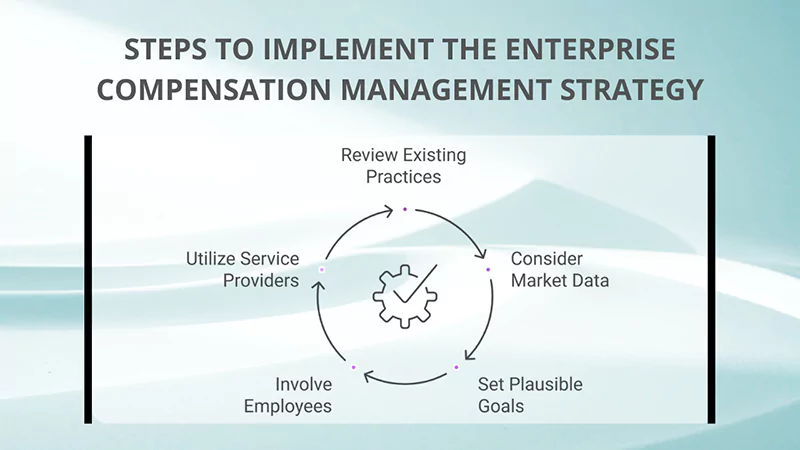
Implementation of a modern enterprise compensation management strategy is a highly transformative project that should touch every level of an organization. Enterprise leaders should execute a structured, step-by-step roadmap that should assist in the creation of a system that is financially sustainable, competitive, and trusted by employees.
Step 1: Review Existing Compensation
Start the process with an audit of existing compensation programs, benefit packages, and dynamics. Compare salaries by department to find any gaps or compression. Determine operational constraints and the use of outdated systems, such as spreadsheets for tracking compensation. Finally, decide whether any previous incentive programs helped motivate employees and retain top talent.
Step 2: Define Governance and Decision Rights
Create clarity in ownership and rules throughout the business. Develop a compensation philosophy to decide whether your organization is a pay leader or lags behind market pay. Create clear roles and processes for HR developing pay bands, the finance department approving budget pools, and managers providing merit increases based on tiered processes.
Step 3: Analyze Market Data
Use market knowledge as the basis for the development of competitive salary bands. Collect reliable data from salary surveys and conduct a mapping of internal job titles to their market equivalents. Make necessary adjustments for changes in the economy, changes in the cost of living index, remote work, etc.
Step 4: Set Realistic Goals and Budgets
Work closely with the finance department to establish realistic budgets for base pay increases, incentive bonuses, and stock grants. Model various scenarios to estimate spending and assess margin effects. Align compensation objectives with corporate objectives like sales growth to calculate the bonus pool payouts.
Step 5: Involve and Communicate with Employees and Managers
Earn their trust by being communicative and providing transparent compensation guidelines. Train your supervisors first about pay policies with clear talking points and frequently asked questions so they will be able to explain the pay decisions with confidence. Be transparent about your pay ranges and incentive bonuses, while collecting employee feedback through surveys.
Step 6: Choose and Deploy an ECM Tool
Move away from outdated spreadsheets and invest in Enterprise Compensation Management (ECM) software to boost efficiency and ensure proper security measures. Pick a solution that is compatible with your existing HR information system and payroll management system. Configure merit increase rules, workflows, and permission settings, and test the system thoroughly before going live with it company-wide.
Step 7: Track Metrics and KPIs
Track and fine-tune your compensation plan continuously based on relevant metrics and talent data. Monitor your offer acceptance rate, high performers’ retention, and pay-for-performance correlation. It is also recommended to run regular pay equity analyses and audits across demographics and adjust salary bands annually to keep pace with dynamic market conditions and business goals.
| Metric | What it Measures |
| Compa-ratio | Compares an employee’s pay to the midpoint of their pay range. |
| Pay range penetration | How far an employee’s pay has progressed through their pay range. |
| Offer acceptance rate | How competitive compensation offers are to candidates. |
| High-performer turnover rate | Whether the organization is retaining high-performing employees. |
| Pay equity gap | Pay differences between comparable roles and demographics that warrant further analysis. |
| Compensation cost as a percentage of revenue | Determines if the organization is spending too much on compensation relative to their revenue. |
Benefits of Enterprise Compensation Management
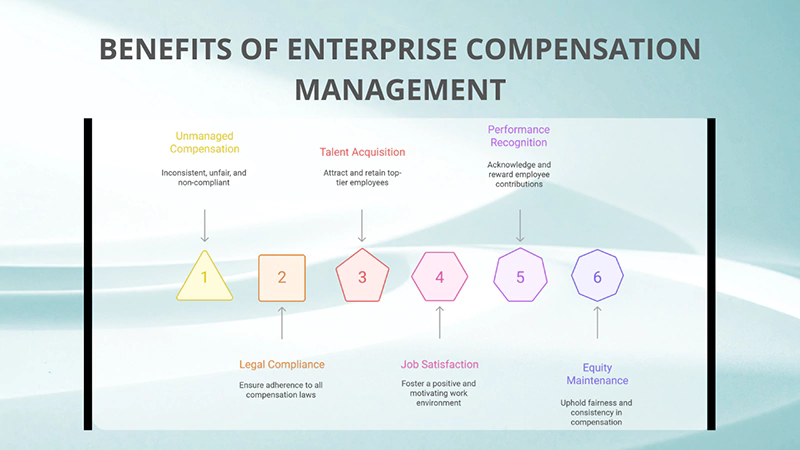
Effective enterprise compensation management delivers clear benefits for organizations and their employees. It also creates the foundation for fair pay, motivation, and alignment with company goals that drive long-term success. ECM has advantages for both employees and organizations.
For employees
The following are the top ways in which ECM can benefit employees:
- Attracts and Retains Top Talent – Having competitive pay ensures that employees feel valued and attracts top talent.
- Improves Job Satisfaction and Motivation – Having fair pay enhances job satisfaction and motivation, and results in more productivity.
- Recognizes Performance – Bonuses and rewards boost morale and also acknowledge hard work.
- Supports Career Growth – ECM also provides training funds, which helps employees to grow professionally.
- Promotes Pay Equity and Fairness – Having a clear view of rewards and bonuses promotes pay equity and fairness among employees.
- Builds Transparency and Trust – Having a clear pay structure also establishes trust and clarity among employees, which results in a respectful work environment.
For the organization
On the other hand, Enterprise Compensation Management is also advantageous to organizations.
- Aligns Workforce Costs with Business Goals – Strategic compensation planning also results in financial stability with talent investment. Workforce costs should be aligned with company priorities, which ensures workforce costs drive measurable results.
- Enables Data-Driven Decisions – ECM removes the guesswork and introduces real-time analytics and market benchmarks. Executives will be able to model scenarios, measure performance, and make strategic compensation decisions based on optimized labor costs and talent recognition.
- Streamlines Compensation Processes – ECM avoids any mistakes made with the help of spreadsheet calculations by automating the processes of salary calculations, bonus allocations, and multi-step approvals. Centralizing these activities helps save time and eliminate possible mistakes.
- Ensures Legal Compliance – ECM systems create an audit trail and enforce payment rules automatically. Pay equity analytics provided proactively ensure compliance with pay transparency legislation.
What are the Challenges Of Enterprise Compensation Management?
While ECM has numerous benefits, it does not come without any challenges of its own. There are a few obstacles that organizations and HR departments may face when managing compensation. Addressing these challenges requires tools and processes that are created for accuracy, transparency, and collaboration.
Subjectivity and Bias in Compensation Decisions
Subjectivity and bias occurs when pay increases, bonuses, and equity allocations depend on the manager’s discretion or personal preferences and perceptions rather than using an objective, standardized metric. This results in a breakdown of trust and often leads to quiet quitting or loss of top talent.
How to address it: Define decision rights and standardize pay criteria (see Step 2). This helps ensure pay decisions rely on objective criteria.
Pay Equity and Internal Fairness
Pay inequities are generally based on geography, role, or other factors that can harm employee trust and company culture. It is essential for companies to identify and correct these disparities even if they are challenging. Inconsistent pay bands and manual processes can obscure gaps and bias in compensation.
How to address it: Run pay equity audits on a schedule and use consistent pay bands for comparable roles.
Market Volatility and Rising Compensation Costs
Market volatility is driven by a number of different factors, such as inflation, economic swings, shifting labour supply and demand, and tech disruptions, and all these factors make it difficult for organizations to handle budgets and manage total rewards over time. Having a dynamic, software-driven compensation platform that assists in resolving this issue.
How to address it: Implement a software-based, flexible compensation platform and utilize it to test compensation scenarios and modifications to budgets, given the pulse of the market.
Meeting Employee Expectations and Retention
Employees always expect transparency and clarity around the total compensation that they are receiving to feel valued and motivated. Having less transparency and a lack of clarity can increase the turnover risk. Employees may feel that they are undervalued without any clear visibility into pay components and their offer details.
How to address it: Provide employees with access to their total compensation and pay ranges. Train managers to have constructive conversations with employees about pay.
Regulatory Compliance and Global Complexity
One of the biggest challenges that companies face is keeping compensation programs in accordance with changing labour laws. What you need to know is that non-compliance can result in legal risks and penalties. There are numerous organizations that struggle with keeping up with these laws and ensuring that their pay policies match all legal requirements.
How to address it: Frequently conduct compliance audits and use an ECM solution to track pay rules by location.
Administrative Complexity and Manual Workflows
Compensation planning also involves different teams and steps, which often cause delays and miscommunication when the process is fragmented and divided. Using spreadsheets and disconnected tools results in inefficiencies and risks errors in approvals and tracking.
How to address it: Replace manual processes with automated, centralized processes (see Step 6).
By addressing these common issues and challenges with the correct approach and technology, organizations can easily create a compensation system that is trusted by all employees and stakeholders.
Conclusion
In the ever-evolving world of HR, enterprise compensation management is an essential step that allows companies to create a motivated, satisfied, and engaged workforce. Having a fair, transparent, and competitive compensation strategy attracts new talent to your business, reduces turnover, and enhances the overall productivity of the company.
Whether you are managing compensation for a small team or you are running an enterprise-level organization, having a well-thought-out ECM strategy is the first step for long-term success. With the correct tools, practices, and commitment, organizations can easily create a compensation structure that not only aligns with the needs of their employees, but also supports their business growth and compliance.
FAQs
1. What is Enterprise compensation management?
Ans: Compensation management is all about creating a strategic approach through which organizations can oversee, implement, and design the compensation system that goes hand-in-hand with employees’ expectations and company goals. It includes different aspects of employee pay, such as bonuses, incentives, and salaries, and any other non-monetary benefits.
2. How does ECM benefit a company?
Ans: Enterprise Compensation Management makes pay a strategic tool for attracting and retaining talent by offering competitive rewards. The solution aligns incentive compensation to performance goals of the business, thus ensuring productivity across different departments.
More importantly, automated ECM software provides strict budget control and an approval workflow, thus not allowing payrolls overruns and administrative challenges in multi-currency, global environments.
3. What tools are used for compensation management?
Ans: Enterprises use a specialized software ecosystem to facilitate pay processes. HRIS systems such as Workday, SAP SuccessFactors, and Oracle Cloud help to conduct global merit cycle programs.
Compensation-specific software such as Beqom and Payscale offers sophisticated planning capabilities, whereas Carta helps to manage equity allocation. Market intelligence solutions such as Aon Radford and WTW provide salary benchmarking.
4. How does ECM support pay equity?
Ans: The concept of fairness through ECM is achieved through the development of job architectures and salaries according to skills, level of position, and geographic area.
Automated regression analysis is performed within the review cycles by the enterprise compensation systems on the basis of identified demographic wage discrepancies. Manager guidance, peer calibration, and audit logs provide easy compliance with pay transparency laws on the global level.
5. How do you measure the success of ECM?
Ans: The assessment of the success of ECM should include the evaluation of several indicators such as talent, finance, and equity measures. The success of the program is indicated by high offer acceptance rates and low voluntary turnover rates among high-performing employees. From the financial point of view, enterprises analyze compa-ratio distribution, compensation-to-revenue ratio, and review budget usage.
6. What types of compensation are included in ECM?
Ans: ECM includes base pay, commissions, bonuses, incentives, and additional benefits like stock options, insurance, and retirement plans.
7. How does ECM benefit employees?
Ans: ECM attracts the best talent, maintains employees’ job satisfaction, ensures equity, recognizes performance, and supports career growth through fair, transparent compensation.
8. Why is reviewing compensation regularly important?
Ans: Regular reviews ensure pay remains fair, competitive, aligned with company goals, and helps retain the trust of the employees.