
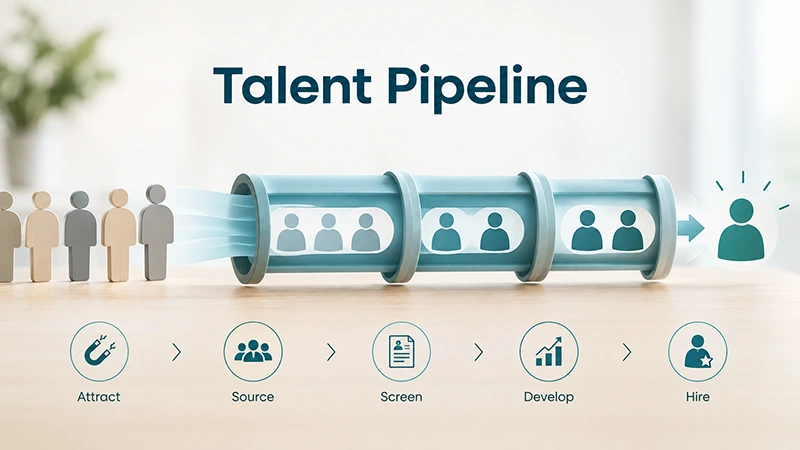
A talent pipeline is nothing but a structured pool of pre-screened candidates that an organisation identifies, engages, assesses, and develops for current and future hiring needs. To build a robust talent pipeline, start by identifying future business needs, understanding the required skills and qualifications, sourcing internally and externally, engaging candidates, and regularly optimizing pipeline health.
LinkedIn’s Recruiting Research highlights that organizations with strong employer brands see 50% lower cost per hire, about 50% more qualified applicants, and close to 28% lower staff turnover. These findings are crucial to learn how a well-planned approach strengthens the talent pipeline and supports long-term workforce planning. Follow this article to learn what a talent pipeline is, its benefits, how to build one, and common mistakes to avoid.
What is a Talent Pipeline? Why Is It Important for Businesses?
According to the Society for Human Resource Management, a talent pipeline is a group of skilled candidates who may join an organization. In simple terms, it is a structured pool of potential candidates that an organisation develops and maintains to meet its current and future hiring needs.
It includes both internal employees and external candidates who may be suitable for specific roles as they become available. Unlike starting the recruitment process when a vacancy arises, a talent pipeline helps an organisation identify and maintain relationships with potential candidates in advance.
Here are the key steps in building a talent pipeline strategy:
| At-A-Glance Steps of Building a Talent Pipeline Strategy | |
| Process | What Happens? |
| Identify Future Hiring Needs | Determine business future goals, roles, and skills required. |
| Define Candidate Profiles | Identify the skills, qualifications, competencies, and experience level required. |
| Sourcing | Identifying potential candidates before the vacancy becomes available. |
| Engage and Nurture the Candidates | Maintain relationships through targeted communication and opportunities. |
| Regular Assessment | Evaluating and categorising candidates based on skills, suitability, and job readiness. |
| Measure and Optimise the Talent Pipeline | Tracking key metrics, such as conversion rates, candidate engagement, drop-off rates, quality of hire, and more. |
Why Building a Talent Pipeline is Crucial for Businesses?
Building a talent pipeline strategy is crucial because:
- Reduce Hiring Delays: Ready talent pipelines offer access to pre-screened candidates, significantly reducing hiring time when a vacancy arrives. SHRM’s 2025 Talent Trends highlight that 69% of organisations find it difficult to fill full-time positions for top roles, making it crucial to build candidate relationships before hiring demand becomes urgent.
- Improves the Quality of Hire: When hiring becomes non-urgent, it gives recruiters more time to assess candidates against role-specific skills instead of making rushed decisions. Hence, recruiters can spend ample time identifying, assessing, evaluating, and comparing candidates before making a final decision.
- Helps Address Skill Gaps: Talent pipelines include candidates who possess the required skills for the future as well as internal employees ready for upskilling, promotions, and succession planning. This is useful for recruitment as well as workforce planning.
- Strengthens Internal Mobility and Succession Planning: Building a Talent Pipeline requires both external and internal candidates, who carry the potential to move into future positions.
Deloitte’s 2025 Global Human Capital Trends research highlighted that 73% of executives and 72% of workers agreed that organizations should do more to provide opportunities for people to gain experience. This is supported by talent pipeline frameworks, which support structured internal development by providing employee development plans.
- Strong Employer Brand: Keeping potential candidates engaged, communicating the company’s culture and values, career opportunities, and employee experience, significantly strengthens employer brand. It attracts the right candidates and keeps them interested as hiring needs arise.
How To Build a Talent Pipeline in 6 Steps
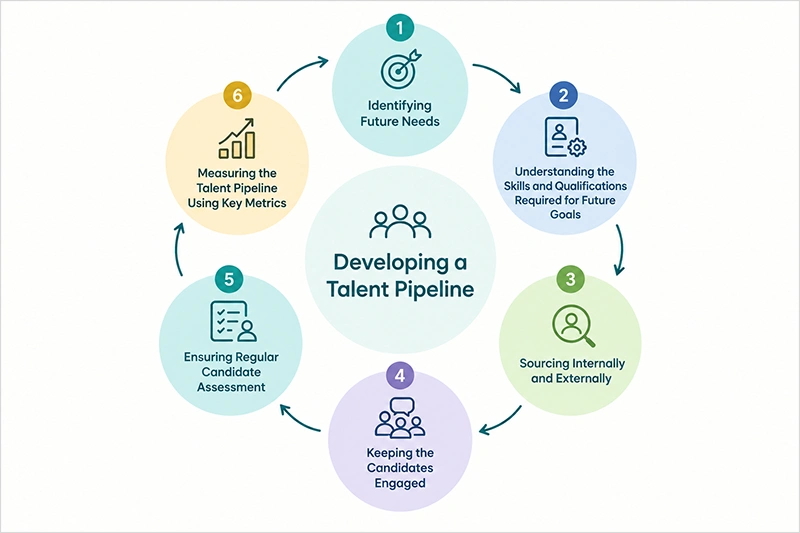
Begin by identifying future needs, understanding the skills and qualifications required for future goals, sourcing both internally and externally, keeping the candidates engaged, ensuring regular candidate assessment, and measuring the talent pipeline using key metrics.
Here’s the process of building a talent pipeline strategy in 6 easy steps:
1. Identify Future Hiring Needs
Begin by determining which roles, skills, and workforce capabilities the business will need in the upcoming years. Identify the business’s long-term goals, review growth plans, expansion plans, upcoming projects, and the roles that are consistently difficult to fill.
Here’s a checklist of what you need to determine to identify future needs:
- Future skill gaps if high-potential people leave
- Forecasting skills required in the future
- Critical roles for future growth
- Identify critical or hard-to-fill positions
- Reviewing retirement trends and employee turnover
- Non-negotiable behaviors and aptitude
Additional Recommendation:
Revisit your forecasts every quarter. As the business evolves quickly, hiring needs shift, and earlier forecasts may not work well.
2. Understand the Skills and Candidate Profiles You Need
Once the business goals are clear, align your future hiring needs with the skills, qualifications, experience level, and role requirements. It should include the core competencies (skills and behaviors), experience, and motivation.
Here’s a checklist of what needs to be included while assessing required skills and candidate profiles:
- Required technical and functional skills
- Qualification and Certification
- Relevant Industry Experience
- Behavioral Competencies and Soft Skills
- Skills that Can Be Developed through Training Programs
3. Start Sourcing From Internal and External Talent Pools
Start building the talent pipelines by sourcing candidates from both internal and external talent pools. An internal pipeline helps build a leadership pipeline and focuses on high-performing employees, ready for promotions and succession opportunities, while an external pipeline focuses on potential candidates outside the company.
Build an Internal Pipeline Through:
- High-Potential Employee Identification
- Succession Planning and Promotions
- Upskilling and Reskilling Programs
- Performance and Potential Assessments
Build an External Pipeline Through:
- Professional Networking Platforms
- Universities and Colleges Placement
- Internships and Apprenticeship
- Industry Events and Recruitment Agencies
Did You Know?
According to LinkedIn, organisations with strong internal mobility programs retain employees nearly 2x longer, while internal hires typically reach full productivity 30–40% faster than external hires.
Hence, map internal employees against future roles, identify high performers, and train them for future roles, instead of simply relying on external hires.
4. Engage and Nurture Candidates
Boosting employee engagement with clear and consistent communication is required to build a positive relationship with your brand, rather than one-time contact. Keep them updated with career opportunities and follow-ups until a suitable position becomes available.
Here are some ways to nurture the candidates:
- Sharing the company’s newsletters and industry updates
- Periodic personalised check-ins
- Inviting candidates to webinars or networking events.
- Creating an alumni network
- Reconnecting when their skills match a new requirement.
Expert Recommendation:
Avoid sharing the same message and updates with everyone. Personalise and tailor your communication according to the candidate’s role, skills, career interest, and stage in the pipeline.
5. Regular Assessment and Segment Candidates
Regularly assess the candidate’s potential with informal assessments, such as evaluating past projects or skill assessments, against predefined requirements and place them into appropriate segments. This enables recruiters to prioritize candidates based on skills, qualifications, and job readiness.
Here’s how you can segment the candidates:
- Ready Now: Qualified for a current or near-term position.
- Ready Soon: Requires minor training and development.
- Future Potential: Could become suitable after a proper training and development program.
- High-Potential Internal Talent: An internal employee suitable for promotion, succession planning, and future responsibilities.
Important Note:
The best assessment should be inclusive; hence:
- Use diverse interview panels
- Address unconscious bias
- Create development plans for internal talent pool
- Conduct regular check-ins
- Strengthen succession planning
6. Measure and Optimize Pipeline Performance
Keep a regular track of recruitment data to find out whether the pipeline is producing qualified candidates, reducing hiring delays, and supporting the workforce requirements. These insights are helpful in determining the bottlenecks and improving recruitment strategies for sourcing and conversion.
Here are the talent pipeline metrics one should determine:
- Pipeline Conversion Rate: Percentage of candidates eventually hired.
- Time-to-Hire: Average time to hire a candidate after the recruitment process begins.
- Pipeline Velocity: How quickly candidates are moving between stages.
- Quality of Hire: Performance and suitability of the newly hired employees.
- Talent Source Effectiveness: Which sourcing platforms are providing the best quality candidates for the talent pipeline?
- Candidate drop-off Rate: Percentage of candidates leaving the recruitment process.
What is the Difference Between Talent Pipeline and Talent Pool?
While a talent pool is a broader concept for a potential group of candidates, such as past applicants and passive prospects, a talent pipeline refers to a group of candidates matched to specific upcoming roles.
Let’s understand the point of difference: talent pool vs. pipeline
| Points of Distinction | Talent Pipeline | Talent Pool |
| Simple Difference | Shortlisted people; ready to be hired for specific roles. | A large library of resumes |
| Scope | Narrow approach; focused on specific skills and hard-to-fill positions. | Includes a large candidate pool, including past applicants and referrals across various fields, skills, and experience levels. |
| Role Alignment | Includes candidates required for specific roles, skills, and future workforce requirements. | May include candidates without a specific role match. |
| Candidate Engagement | Requires consistent outreach to keep them informed, nurtured, and engaged. | Light engagement with the organisation. |
| Example | Shortlisted 20 pre-screened software engineers for expected hiring needs in the upcoming years. | A database of 500 technology professionals ready to work for an organisation. |
Best Practices and Tips to Build a Strong Talent Pipeline Framework
Prioritizing hard-to-fill positions, identifying skills and competencies, creating consistent evaluation criteria, and keeping the candidate engaged are the best practices for building a strong talent pipeline framework.
Here’s what you need to know:
1. Prioritize Hard-To-Fill Positions
Roles that require a specific skill generally take longer to fill. Hence, building these pipelines in advance gives recruiters an edge over business operations and gives them more time to identify and engage suitable candidates.
It is recommended to focus on:
- Specialised or Technical Roles
- Roles Requiring Scarce Skills
- Positions That Take High Time to Fill
- Leadership and succession-critical positions
Example: Filling senior management positions can be difficult; therefore:
- Identify the high-performing employee
- Acknowledge the skill gap
- Provide learning and development programs
- Align their competency with that of a senior position
2. Skill-Based Candidate Profiles
According to LinkedIn’s Future of Recruiting Report 2025, companies with the most skill-based research were 12% more likely to make a quality hire. This highlights the importance of defining candidates by their skills and core competencies. It also helps recruiters identify transferable skills and potential.
The key is to create profiles based on:
- Must-Have Skills
- Transferable Skills
- Behavioral Competencies and Soft Skills
- Future Skills Required for the Role
- Experience Level
3. Keep the Candidates Engaged
Maintain your brand’s relationship with the candidate even when there is no immediate vacancy. Use personalised communication, networking events, and career opportunities to keep suitable candidates connected with the organisation.
4. Create a Consistent Assessment Process
Use standardized criteria to evaluate candidates consistently and remove unconscious bias. List the clearly defined competencies and take structured interviews to determine which candidate is suitable for current and future roles and which require further development.
Strengthen the assessment process by:
- Defining the evaluation criteria before the interview
- Keeping a diverse interview panel
- Reviewing candidates against the same criteria
- Assessing relevant skills and structured interview questions.
Common Mistakes While Developing a Talent Pipeline Framework and How to Avoid Them
Here are some common challenges and mistakes while developing a talent pipeline framework and their solutions:
| S No. | Common Mistakes | Solutions |
| 1. | Focusing only on External Candidates | Identify internal high-performing employees suitable for promotions, succession planning, and future responsibilities. |
| 2. | Prioritizing Quantity over Quality | Avoid data hoarding and clearly define candidate criteria, including relevant experience, readiness, and role. |
| 3. | Generic Outreach | Avoid sending the same engagement messages. Tailor it to suit each candidate’s role, skills, and stage in the pipeline process. |
| 4. | Inconsistent Assessment Criteria | Remove unconscious bias by keeping diverse interview panels and setting standardized assessment criteria. |
| 5. | Using Outdated Data | Schedule regular database reviews and pipeline maintenance. |
| 6. | Not Measuring Pipeline Performance | Track the key metrics, such as conversion rate, candidate engagement, quality of hire, drop-off rate, and more. |
Suggested Reading: Know Why Your HR Communications Need a Conversion Focus
Final Thoughts
To sum up, strong talent pipelines identify future hiring needs, source internal and external candidates, nurture brand relationships with them, and track key recruitment metrics to maintain a ready pool of qualified candidates. The key is not just to list the names and build a large candidate database but to develop a structured, role-relevant pipeline that supports both current hiring and future business hiring needs.
Frequently Asked Questions (FAQs)
1. What is the talent pipeline?
Ans: A talent pipeline is a pool of qualified and potential candidates that an organisation builds and maintains for current and future hiring needs. It may include internal employees as well as external hires.
2. How to develop a strong talent pipeline framework?
Ans: Start by identifying future hiring needs and understanding the core competencies required. Source the candidates internally and externally, keep them engaged, assess their suitability, maintain candidate information, and measure pipeline performance.
3. How long does it take to build a talent pipeline?
Ans: Building a talent pipeline framework is a continuous process rather than a one-time project. Hence, the timeline depends entirely on the hiring volume, role complexity, talent availability, and sourcing channels available.
4. What is the difference between a talent pipeline and a talent pool?
Ans: While a talent pool is a broader term for a potential group of candidates, such as past applicants and passive prospects, a talent pipeline refers to a group of candidates matched to specific upcoming roles.