

Human Resources is a crucial department for any organization, handling complex employee relations and managing the workforce to meet the goals of the business. Bridging the gap between the employees and the organization, the role of HR Professionals is paramount, whether in a big firm or a small enterprise.
To fully understand what is human resources, what they actually do, how they are valuable for the company, and how to become a reputable HR Professional, follow this article.
What is Human Resources?
Human Resources functions as a department within an organization, responsible for managing the workforce and HR practices such as employee lifecycle management, training and development, performance analysis, onboarding and offboarding. Human Resources functions as a catalyst between the employees and the organization, working consistently to align organizational and employees’ goals.
What does Human Resources do?
Managing the entire lifecycle of an employee, conducting disciplinary actions, ensuring workplace safety, employee engagement, and conducting benefit analysis are some of the key roles of human resources.
Human Resources is generally associated with hiring, orientation, and payroll management, but its role goes beyond, and we have discussed that below.
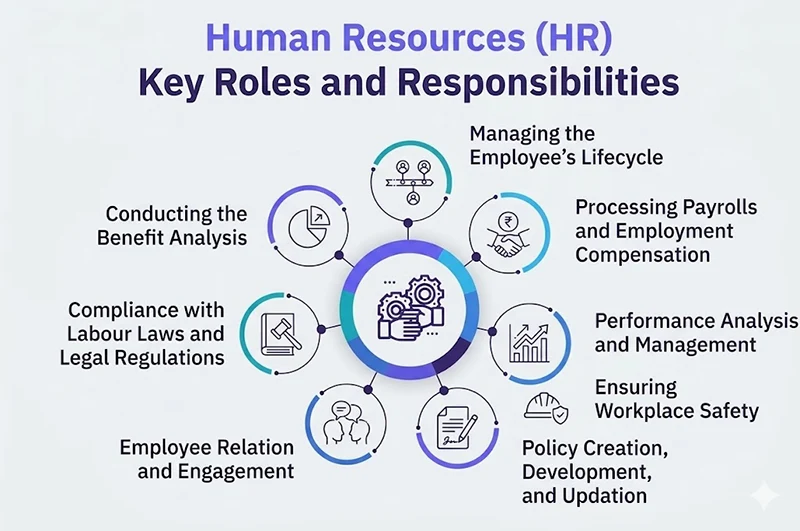
Key Roles and Responsibilities of Human Resources:
- Managing the Employee’s Lifecycle
- Processing Payrolls and Employment Compensation
- Performance Analysis and Management
- Ensuring Workplace Safety
- Policy Creation, Development, and Updation
- Employee Relation and Engagement
- Compliance with Labour Laws and Legal Regulations
- Conducting the Benefit Analysis
1. Managing the Employee’s Lifecycle
The first and foremost task of human resources is to manage the employee lifecycle (recruitment, hiring, onboarding, training, and offboarding).
- Recruitment: HRs are required to understand the company’s needs and recruit employees accordingly. Recruiting involves: crafting clear job descriptions, asking good questions in an interview, sourcing through trusted platforms like LinkedIn, Indeed, etc, and finally interviewing and screening.
- Onboarding: This is a crucial pre-joining phase. HRs are required to ensure the completion of the necessary paperwork, hand over the job offer letter, inform the candidates about the work culture, conduct orientation, and document signing.
- Training and Development: Training employees requires HR to equip them with the necessary skills. Workshops, mentoring, and training sessions are crucial to shape employees’ careers.
- Offboarding: It marks the end of the employment period with the company. It involves the return of company assets, the transfer of responsibilities, the conduct of exit interviews, and the completion of all necessary documentation.
2. Processing Payrolls and Employment Compensation
One of the most critical duties of an HR is processing payroll.
What is a Payroll?
Payroll refers to the process of paying employees’ salaries, which includes collecting employees’ attendance and leave data, calculating the gross pay, and finally releasing the net salary.
Payroll processing and employee compensation involve:
- Collecting the employees’ total hours and leaves
- Calculating the deduction and overtime
- Reimbursing the expenses
- Calculating direct employee compensation: bonuses and commissions, and indirect employee compensation: paid leaves, health insurance, and retirement plans.
Releasing the net pay and salary slips
3. Performance Analysis and Management
Measuring employees’ productivity and efficiency helps HR determine their bonuses, raises, and promotions. It involves analyzing data-driven insights, such as KPIs and feedback.
Day-to-day responsibilities involve:
- Analyzing the skill gap and scheduling the individualized training and development plans, also called Performance Improvement Plans (PIPs).
- Identifying the top performers for rewards, appraisals, or potential leadership opportunities.
- Setting goals that align with the business and employees’ objectives.
- Providing feedback and constructive input.
4. Ensuring Workplace Safety
HRs are bound to take proactive safety measures and ensure the workplace complies with the Occupational Safety and Health Act of 1970.
HRs can create a safe environment by:
- Spreading awareness through communication
- Implementing strict safety policies
- Encouraging employees to report harassment
- Conducting thorough background checks before hiring
- Implementing an Employee Assistance Program (EAP) for psychological support.
5. Policy Creation, Development, and Updation
HRs are responsible for drafting, developing, and updating clear policies and rules that ensure fairness and legal and business compliance. It is equally important to revisit and update previous policies to meet the current requirements.
The key policy management duties of HR include:
- Consulting stakeholders and upper management for input and review.
- Drafting clear and compliant policies that include rules about remote work, WFH, freelance opportunities, work culture, health, and safety.
- Communicating the policies and rules to employees.
- Consistently monitor the adherence to policies and frameworks.
- Updating the policies that do not serve the business and employees.
6. Employee Relations and Engagement
Constructing a positive work culture, boosting employees’ morale and engagement, conducting team-bonding activities, and ensuring clear communication help HR maintain successful employee relations and manage employee engagement.
HRs can build employee relations by:
- Supporting work-life balance and well-being initiatives.
- Facilitating team development.
- Consistently tracking the engagement levels.
- Ensuring strengthened communication channels.
7. Compliance with Labour Laws and Legal Regulations
One of the core duties of HR is to ensure compliance with the labour laws and legal regulations. It must ensure that the organization adheres to the internal policies and statutory requirements. Non-compliance can result in penalties, fines, and financial losses.
The HR’s should:
- Draft legally binding contracts
- Ensure adherence to labour laws and anti-discrimination policies.
- Handling grievances
- Creating and updating policies.
8. Conducting the Benefit Analysis
In a market that offers cut-throat competition, HRs are required to be conscientious. They should consistently investigate the perks and benefits their competitors offer. A potential top performer may choose another company with lower pay if the benefits are attractive.
To retain and attract the best talent, HR should:
- Offer superior benefits to their competitors.
- Conduct market analysis consistently.
- Increase compensation and wellness programs.
How Human Resources Drives Organizational Success and Employee Experience?
By recruiting top talent, fostering a positive work culture, ensuring employee safety and well-being, and training employees to be adaptable and change-ready, human resources functions as a strategic partner that maximizes the company’s ROI on people and enhances the employee experience.
How Human Resources Adds Value to the Company?
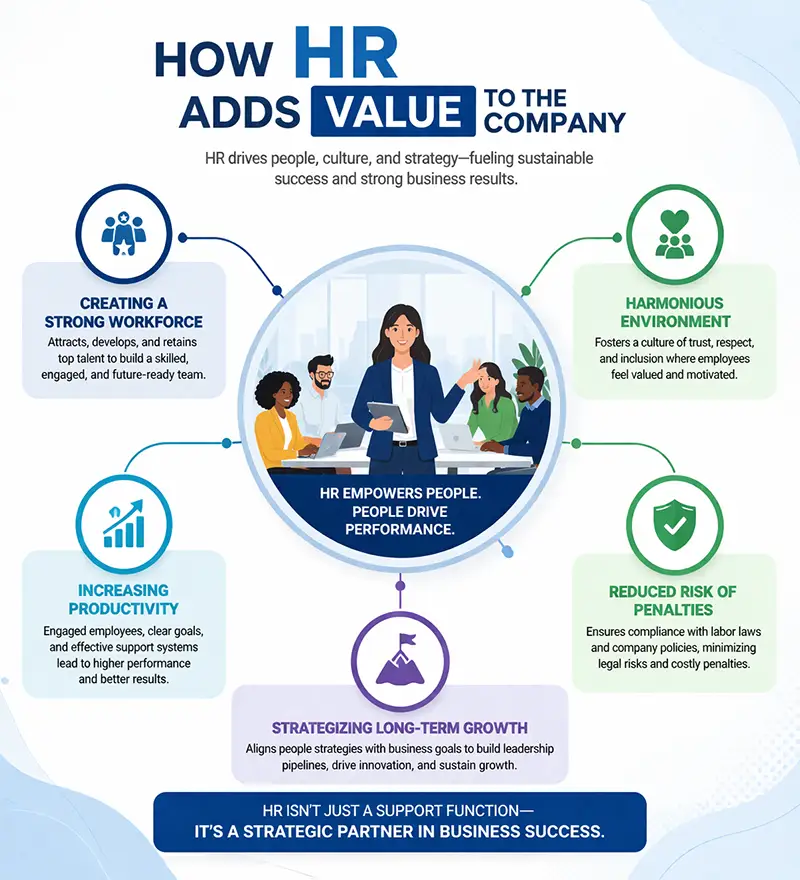
Here’s how human resources drives the organizational growth:
- Through strategic talent acquisition and retention, HRs create a strong workforce that increases the turnover and significantly reduces potential financial losses from bad hires.
- Consistent performance analysis, constructive input, and feedback help the individual to align with the business’s objectives. It significantly increases productivity and allows them to focus on what really matters.
- HRs bridge the gap between employees and the organization. By considering the employee’s grievances, HRs foster a harmonious workplace.
- Human Resources reduces the risk of financial penalties and loss of credibility by adhering strictly to legal regulations and labour laws. It fosters a transparent working environment that benefits both the organization and the employees.
- Known for deriving the business growth strategy, human resources aligns HR practices with business objectives and strategizes long-term growth. It identifies the potential leaders and nurtures successive planning, improving efficiency and workforce planning.
- By implementing Diversity, Equity, and Inclusivity (DEI) measures, human resources creates a welcoming environment for individuals with diverse backgrounds, without prioritizing a specific demographic.
How Human Resources support employees?
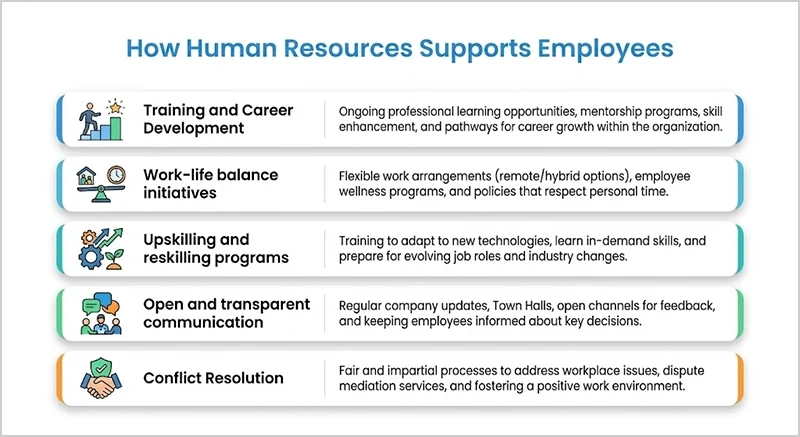
Human Resources is beneficial not only to the organization but also to employees, helping them grow in a competitive environment.
Here are some ways in which HRs support employees:
- Training and Career Development
By conducting training programs that equip employees with the required skills needed to be adaptable and change-ready, HRs help the employees grow and define their career path.
- Taking Work-Life Balance Initiatives
A company is not only liable for the financial benefits, but also for the psychological ones. A disrupted work-life balance hampers the employee’s productivity. How can HRs step up to resolve this issue?Implementing a hybrid work model wherever possible, along with remote working arrangements, can help employees perform better.
- Launching Upskilling and Reskilling Programs
Continuous educational and upskilling programs through mentorship and training enable the employees to be future-ready and competitive in an ever-evolving competitive market. Managers should be given formal training to make them as efficient and functional as possible.
- Encouraging Open and Transparent Communication
Clear and transparent communication is crucial for a harmonious workplace. HRs should promote this by encouraging the employees’ feedback and suggestions, identifying the need for improvements, and taking accountability to act on the grievances of employees.
- Conflict Resolution
By serving as a mediator during conflict and addressing their concerns, employees feel valued and supported. Addressing sensitive issues without bias or unfair treatment builds trust among the employees.
Hence, human resources works for the benefit of both the employees and the organization. It consistently aims to align individual goals with the organization’s objectives.
What are the Different Types of Human Resource Support?
An organization has two options when hiring an HR professional: it can hire an in-house HR professional or outsource to an external expert. Both options come with their own set of pros and cons.
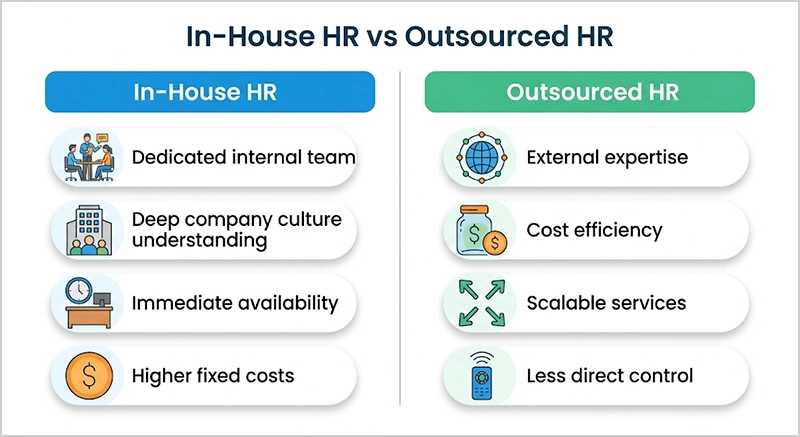
| Points of Difference | In-House HR | Outsourced HR |
| Meaning | An in-house HR professional manages the employees’ life cycle with greater control and cultural alignment. | Outsourcing HR means hiring an outsourced expert who cost-effectively manages the HR practices. |
| Control | In-house HR has higher access to direct control over the company’s policies, HR practices and decisions. | Control is limited in the hands of outsourced HR due to lower cultural alignment and limited touch with the organization. |
| Expertise | In-house HR might need to be trained regarding the new laws to maintain the same level of expertise. | Outsourcing provides immediate and up-to-date expertise on the employment laws. |
| Costs | Expense on an in-house HR can be comparatively higher (salaries, benefits, leaves) | Outsourced HR significantly reduces these costs because it charges a project-based or subscription fee. |
Here are the pros and cons of in-house and outsourced HR, which will help you to select the one that suits us better:
| Type of HR | Pros | Cons |
| In-house HR |
|
|
| Outsourced HR |
|
|
Which One Should You Choose?
Hire an in-house HR team if you are a large and well-established firm. For complex employee relations and on-site management, hiring an in-house expert can make a difference.
Outsourcing HR is the best practice for small to medium-sized businesses. It controls costs, provides expert support, and allows the organization to focus on the core business by offloading administrative tasks.
Is there any Difference Between Human Resource Management and Personnel Management?
Although both terms are used interchangeably, there’s a notable difference between human resource management and personnel management. While personnel management handles administrative tasks like hiring, processing payrolls and the rest, HRM has a broad scope and focuses entirely on making the efficient use of manpower in addition to the administrative tasks.
Let’s understand the key differences between HRM and personnel management:
| Points of Difference | Human Resource Management | Personnel Management |
| Meaning | This branch of management focuses on the efficient use of manpower to achieve organizational goals. It considers the employee as a valuable asset that drives the company’s growth. | Personnel management deals with administrative tasks and maintaining employee relations with the company. |
| Goal | Working for the growth and development of the organization and its employees. | Managing administrative tasks to handle the people at work. |
| Major Functions | Training and Development of employees, staffing, strategic workforce planning, and employee relations. | Hiring, onboarding, screening interviews, and processing payroll. |
| Employee Relations | Collaborative | Formal |
| Type of Function | Routine | Strategic |
Hence, the two terms differ in their job roles, goals, and functions.
How Does Managetrix Facilitate HR Tasks?
Effectively managing human resources can sometimes be complex and daunting. Using reliable HR software like Managetrix goes a long way. Managetrix is known for providing proficient solutions to the complex issues and streamlining the HR processes, such as payroll and performance management, for over 10,000 businesses across Europe.
With the affordable pricing starting at just $499, Managetrix is a one-stop shop for all HR needs. The user-friendly experience, comprehensive dashboard, team and shift management, and employee management streamlines the organization’s workings.
Trusted by millions of reputable companies, including LG, Himalaya, Amazon, and more, Managetrix is a top choice in the market.
Prominent Types of HR Roles
Human Resource Manager, Generalist, Recruiter, Talent Acquisition Expert, and Strategic and Operational HR are among the most prominent HR roles.
Here’s everything you need to know about their job roles and functions:
| Human Resource Manager | Wider scope: managing employees’ lifecycle, aligning business and employees’ goals, and overseeing administrative tasks. |
| Hiring Manager | The hiring manager supervises staffing, selects the best-suited candidate, develops job descriptions, and finally onboards the candidate. |
| Compliance and Risk Management HR | Oversees adherence to labour laws, legal regulations, internal policies, handling employment contracts, and enforcing anti-discrimination and anti-harassment policies. |
| Talent Acquisition Expert | Talent mapping, strategic workforce planning, and building the company’s reputation to attract the best talent. |
| Employees Relation HR | Building a positive work culture and implementing policies that benefit employees |
How to Pursue a Career in Human Resources?
Strong foundational knowledge, academic endeavour, and understanding of the competencies are required to pursue a career in Human Resources. If you’re wondering how to become HR Manager, then follow the guide:
- Gain a Degree: Get a bachelor’s degree in Human Resource Management or Business Administration. Short-term courses such as employee relations, employment laws, and organizational behaviour are perfect for beginning your career.
- Acquire Experience and Exposure: Get the relevant experience through internships and entry-level roles to understand daily HR practices and tasks.
- Select a Niche and Learn the Key Skills: Discover the various niches, such as employee relations, organizational behaviour, Learning & Development (L&D), HR Analytics, and more, that suit your interests and develop the skill set to manage employee concerns and conflicts.
- Get a Relevant Certificate: Become a reputable HR by gaining a relevant certificate like SHRM-CP (Society of Human Resource Management).
- Advance Career Growth: To become an HR Manager, constantly upskill yourself. You can pursue an MBA in Human Resources to pursue prominent posts such as HR Director, HR Manager, and more.
Conclusion
To sum up, human resources human are crucial for any organization to manage complex relationships. As the business expands, relationships become more complex, and this is where HR professionals step in to ensure a seamless workflow. It’s a crucial position that keeps the organization and its work intact while ensuring a healthy environment and fulfillment of short-term and long-term goals.
Frequently Asked Questions (FAQs)
1. What is Human Resources?
Ans: Human Resources functions as a department in an organization that is responsible for managing the workforce and performing essential HR tasks, such as payroll management, performance analysis, policy enforcement, and more.
2. What does human resources do, and what are the key responsibilities and roles of HR?
Ans: Managing the employee lifecycle, processing payroll and employment compensation, conducting performance analysis, ensuring workplace safety and employees’ engagement, complying with rules and regulations, policy formation, and maintaining employee relations are some of the core roles and responsibilities of human resource professionals.
3. What are the skills required to become an HR professional?
Ans: Excellent communication skills, conflict resolution, leadership qualities, management, strategic thinking, information about legal provisions and laws, and problem-solving capabilities are some of the skills required to become an HR professional.
4. When should I contact HR?
Ans: When you want to register complaints about the harassment or unfair attitude in the organization, ask questions about payroll, benefits and compensation, inform about a change in personal circumstances, or request medical or maternity leave, you can contact your HR.
5. How does HR help to support employees?
Ans: By providing continuous education, training, and mentorship programs, enforcing the work-life balance initiatives, supporting employees’ well-being and health, encouraging clear communication, and resolving conflicts without bias, HR fosters a harmonious environment, enabling employees to contribute their full potential.
6. Which one is better: in-house HR or External HR professionals?
Ans: Selecting in-house or external HR depends entirely on your business model, goals, and requirements. For small to medium businesses, outsourced (external) professionals are better as they are comparatively cost-effective. For large established firms, an in-house HR professional will do wonders, leveraging their immediate presence and ground support.