

Can you remember what correspondence happens more often between you and HR?
Yes, it is through the casual leave application to get day-offs.
In general terms, it is a formal communication between the employee and the administration of the firm through which the employee requests leave for urgent work.
Here we will explore its actual format, its rules, and what its policy should contain.
So let’s hop into it.
What is Casual Leave Application?

Casual leave application is a professional correspondence between the employee and the company’s administration to grant leave to the employee for any unforeseen work. These are generally requested to handle urgent personal matters.
However, their rules are typically mentioned in the leave policy document of the firm or the organization, which governs their entitlement.
These leaves have certain salient features, such as:
- Paid in nature.
- It can’t be clubbed with other leaves.
- No prior notice is required; hence, it can be requested on the spot.
- Have a permissible limit.
- Can be encashed at the end of the year (depending on the firm’s rules).
A type of it called compensatory casual leave is also offered in some institutions, especially government organizations. These leaves are granted to the employee in place of working on holidays or overtime.
Also, the central government of India and some state governments provide special casual leave, which is entitled for a few highly specific reasons, such as:
- To Participate in Sports and Cultural Activities
- For Family Planning
- For Ex-Servicemen
- to take part in Association Activities
All these factors are subject to the leave rules of the organization.
Suggested Read: FTE Meaning: Definition, Calculation, Purpose, and More
What are Casual Leave Rules?
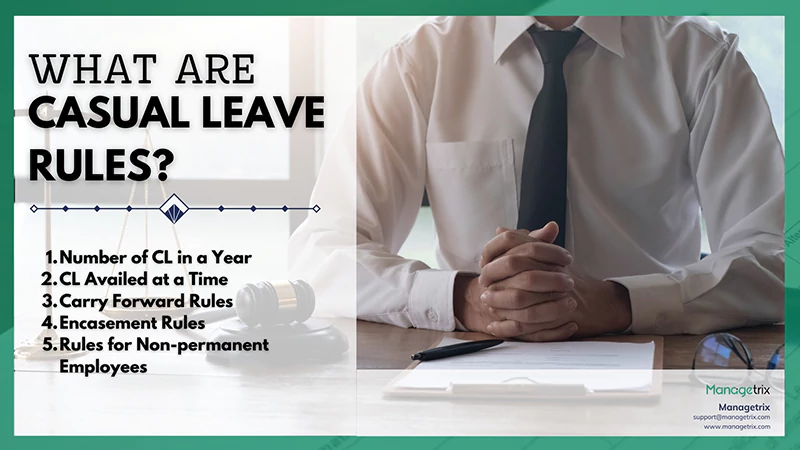
The rules of availing casual leaves are generally mentioned in a separate section in the employment contract or in the leave policy document released by your firm or organization.
However, certain rules are universally mentioned in the rulebook to address common misconceptions about it. These rules are:
- Number of CL in a Year: There is a specific number of casual leaves that the employee is entitled to annually.
- CL Availed at a Time: The employees are also bound to claim a fixed number of such leaves at a time. However, more leaves can be requested by contacting the higher authorities.
- Carry Forward Rules: Casual leave typically cannot be carried forward, like in the US. All unused leaves usually expire at the end of the year.
- Encasement Rules: Casual leave can be encashable. However, it totally depends on the prevailing rules of the organization.
- Rules for Non-permanent Employees: The leave rules for probationers, freelancers, and contractual employees are generally different from those of permanent employees.
Let’s take the example of US federal employees to understand the casual leave meaning comprehensively.
For corporate and contractual employees in the US, the leaves are calculated through the base rate that each worker is entitled to as per their employment contract.
For federal employees, the leave entitlement depends on their year of service, as mentioned below:
| Service | Leave Entitled |
| Less Than 3 Years | ½ day for every pay period |
| 3-15 Years | ¾ day for every pay period |
| More Than 15 Years | 1 day for every pay period |
Furthermore, the US casual leave rules for central government employees also recognize the “use-or-lose” rule, i.e., the leaves not utilized will be forfeited and will not be carried to the next year.
Also, there has been a ceiling for leaves that the federal employees can claim, which is mentioned below.
| Employee | Leave Day Ceiling |
| US based | 30 days |
| Non-US based | 45 days |
| Professional and Senior employees | 90 days |
On the other hand, the normal central government employees in India get 8 CL per year, and disabled employees get 12 per year. These leaves can be granted for a maximum of 5 at a time.
If the employee requests more than 5 days’ leave, he/she must contact higher authorities. The rules also mention that Sundays and holidays during the leave term are not considered part of CL.
Talking about the private firms and establishments, 7-12 days of CL are provided annually in India, which depends on the local legislation and the company’s rules and policies.
Casual leave rules for state government employees also differ significantly in a particular country. For example, Meghalaya state of India has legislated for 30-day special casual leave for the state government employees, while this count is much lower in other states.
If the employee requires more leave, then he/she can avail other leaves, and in case he/she have exhausted all options and still requests for day off, it will lead to loss of payment (LOP).
For What Reasons can Casual Leave be Requested?

Casual leaves are granted for certain reasons, such as serving family commitments, facing health issues, or for any personal issue or occasion.
Here are some casual leave reasons that are universally considered valid.
- Family Commitments: Married employees can ask for casual leave to go to children’s parent-teacher meetings, attend weddings, and fulfill similar responsibilities.
- Personal Reasons: You can also claim such leaves for shifting home, supervising house maintenance works, etc.
- Health Issues: Suffering from a fever or a common cold is normal in winter, for which you can take CL. You can also take it for any appointment with a specialist or dentist.
- Legal and Administrative purposes: Voting, visiting courts, applying for government documents, etc., are also considered casual leave reasons.
- Religious Occasions: Many companies and organizations don’t consider local festivals as holidays, for which you can apply for CL to celebrate.
- Vacation and Trip: You can plan a family trip or outing with friends and ask for casual leave for it.
What is the Casual Leave Application Format?

Causal leave is an official conversation between the employee and the administration of the firm or institution. Hence, it needs to be structured formally to uphold professionalism.
The format of the casual leave letter contains some essential elements, such as:
- Addressee: The casual leave application must have the details of whom it is being sent to.
- A Clear Subject line: The subject line in the application or mail should be short, crisp, and to the point, such as:
- Request for Casual Leave
- Casual Leave Application
- Leave Request for (date/dates)
- Application for One-Day Casual Leave
- A Valid Reason: In the body of the application, mention the reason for taking the leave. Your reason should be genuine and specific.
- Specific Dates: The starting and ending dates of your leaves must be mentioned clearly.
- Your Details and Signature: At the end of the document, add your name, designation, and signature to authenticate your casual leave application.
- Details of Second in Authority (if taking longer leaves): If you work at a significantly higher position, you can delegate your task to any subordinate or colleague you feel fit for it and mention his/her name in the application.
Considering the above elements, here is the casual leave application format that you can refer to for structuring an application.
| Manager’s Name/ HR’s Name Designation Firm/Organization Name Subject: _____________ Respected Sir/Ma’am ——————————————————————————- ————————————– (Body) ——————————- —————————————————————————— Yours sincerely, Your Name Designation Signature |
If you are still having problems framing an application for casual leave, we are providing 5 samples of casual leave applications for common purposes.
Sample 1
(For Urgent Work)
| Manager’s Name/ HR’s Name Designation Firm/Organization’s Name Subject: Casual Leave Application Respected Sir/Ma’am I am writing to request a one-day leave for urgent personal work that cannot be postponed. I must attend a family matter involving the settlement of a financial dispute at my ancestral property, which requires my signature to resolve. I apologize for the short notice and understand the inconvenience caused. I have ensured that my team will manage all ongoing work during my absence. However, I will be available via phone for any urgent issues and will resume work promptly the next day at the usual time. Thank you for your understanding and consideration of my request. Yours sincerely, Your Name Designation Signature |
Sample 2
(For Medical Issue)
| Manager’s Name/ HR’s Name Designation Firm/Organization’s Name Subject: Casual Leave Application Respected Sir/Ma’am I request leave for (number of days) from (start date) to (end date) to attend a medical emergency concerning a close relative residing in my hometown in Rajasthan. I will, therefore, be away from the station for (number of days) and shall resume duties from (date of re-joining). During this period, I will remain accessible on my mobile number and email, and my responsibilities will be handled by (name of second in authority) in my absence. I shall be grateful for your kind consideration of my leave request. Yours sincerely, Your Name Designation Signature |
Sample 3
(For Attending a Local Festival)
| Manager’s Name/ HR’s Name Designation Firm/Organization’s Name Subject: Casual Leave Application Respected Sir/Ma’am I am writing to request casual leave for two days, i.e., (dates), to celebrate (Festival name) with my family in my hometown. I have already completed my work and have briefed Mr. X on the current status of all ongoing projects, and all client deliverables due this week have been completed. I will also ensure that my team has clear written instructions for any tasks that may arise during my absence. Likewise, I would be grateful if you could kindly consider and approve this leave request. Yours sincerely, Your Name Designation Signature |
Sample 4
(For Vacations)
| Manager’s Name/ HR’s Name Designation Firm/Organization’s Name Subject: Casual Leave Application Respected Sir/Ma’am I am writing to request approval for a leave of absence from (starting date) to (end date) for a trip to (place name) with my family. During this period, I would like to avail vacation leave for these five days. In my absence, my teammates will manage my responsibilities, for which I have delegated my duties. I kindly request you to approve my vacation leave for the above-mentioned period, and I look forward to your positive response. Yours sincerely, Your Name Designation signature |
Sample 5
(For Personal Reasons)
| Manager’s Name/ HR’s Name Designation Firm/Organization’s Name Subject: Casual Leave Application Respected Sir/Ma’am, I wish to inform you that I am required to accompany my younger daughter to her school’s Annual Day function tomorrow, which will be held throughout the day. So, I will be unable to attend the office tomorrow, i.e., (Date). I have briefed (colleague’s name) on the status and details of the projects currently under my charge, and he/she is adequately prepared to manage them in my absence. I shall remain available on my phone and email for any urgent or important matters. Thank you. Yours sincerely, Your Name Designation signature |
What Should a Casual Leave Policy Include?

Every organization has a leave policy or rule book that mentions fundamental regulations for taking leave.
As casual leaves are frequently claimed and most often asked for, framing rules and providing them authoritatively is very important.
For this, here are some pivotal points that need to be considered for making a casual leave policy.
- Align it with the legislation: Certain laws and regulations prevailing in the native countries, such as the Factories Act in India and the Family and Medical Leave Act in the USA, are to be considered.
- Mention the Procedure: The policy should provide a detailed and stepwise process of how to apply for it and whom to contact to request it.
- Ensure Transparency: To maintain fairness and equity between the employees, it should explicitly provide details about the CL for permanent employees, freelancers, part-time or contractual employees, etc.
Conclusion
From the aforementioned points, we can infer that a casual leave application is a formal medium of communication between the employee and the administration, allowing the former to take leave for urgent work.
It helps employees manage unexpected personal commitments while staying aligned with company policy and statutory guidelines. This makes it crucial to stick to the format for writing it to maintain professionalism.
Next Read: Bereavement Leave: What It Is and How It Works
FAQs
1. What is casual leave?
Ans: Casual leave is paid leave for unforeseen or urgent personal work, typically for short-term and requested without prior notice.
2. For what reasons can casual leave be granted?
Ans: The reasons for casual leave can include family commitments, health issues, legal matters, religious occasions, and personal emergencies or events.
3. How many casual leaves can be taken annually?
Ans: The casual leave rules differ from country to country and firm to firm. So there is no universally recognized number for it.
4. Does CL carry forward?
Ans: CL carry forward depends on the firm/organization’s rules. However, most of the firms consider encashing them at the end of the year.