

While scrolling through employment ads on the job portals, what pitches to you the most?
Yes, it is the salary that always hooks your attention. It is the first thing you focus on in a job ad that you consider before applying for the job.
Though it varies a lot according to the profile, the firms have intricate regulations and conditions for gross and net pay.
But you might have a doubt: what is net pay?
So in this blog, we will learn about the net pay definition, its difference from gross pay, its formula, its importance, and what factors cause its reduction.
What is Net Pay?
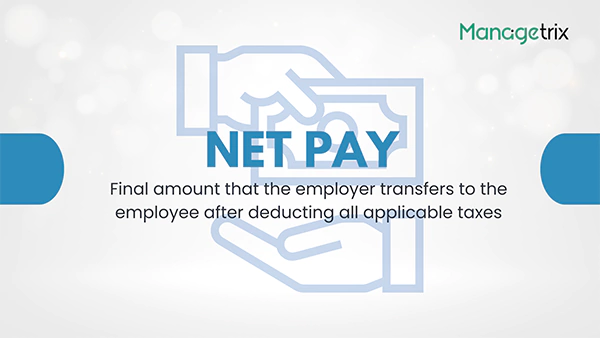
Net pay is the final amount that the employer transfers to the employee after deducting all applicable taxes and other expenses. In simple terms, your CTC is like your gross salary, and your in-hand salary is your net pay. The difference between them is due to the deductions made from the gross income, which results in the net payment.
These deductions can be obligatory or optional. Some obligatory deductions are Medicare and Social Security taxes, and others. Similarly, some optional or voluntary deductions are also there, which vary depending on the local laws and prevailing rules. These aspects clearly define net payment.
Your net pay is also referred to as net income, net earnings, or take-home income. However, it is sometimes misunderstood as gross pay.
For this, we will discuss the difference between gross pay and net pay in the subsequent topic.
Also Read: What Is a Joining Letter? The Professional Template You Need to Make First Impression Count
How is Net Pay Different From Gross Pay?
The gross pay is the salary on which you were hired, while the net pay is the in-hand salary you receive from your organization after subtracting all deductions and taxes.
To understand this distinction more clearly, here is a tabulated comparison of gross pay vs. net pay.
| S. No. | Gross Pay | Net Pay |
| 1 | Don’t contain deductions | Contains deductions |
| 2 | Shows the initial payment | Shows the final payment |
| 3 | Shows day-to-day | Helps long-term planning for the firm |
| 4 | Decided after the employee joined | Helpful in salary negotiation |
| 5 | Give clarity in the profile and status. | Used for comparing jobs and profiles |
Now, let’s learn about the net pay formula to holistically understand the topic under discussion, i.e., ‘what is net pay’.
What is the Formula for Net Pay?
The net pay formula is a simple equation used for deriving your actual in-hand income. It is calculated by subtracting all deductions, such as income tax, provident fund, health insurance premiums, etc., from your gross pay. These deductions vary for every employee, making a difference in the net pay of 2 employees recruited at the same CTC.
To simplify your understanding of “what is net pay”, here is its formula:
Net Pay = Gross Pay — Deductions and Taxes
These deductions vary based on your income, employer, imputed income, benefits package, and pay periods, making net pay the actual amount you receive on payday.
After learning the net payment definition, let’s unearth why understanding it is important.
Why is Net Pay Important?
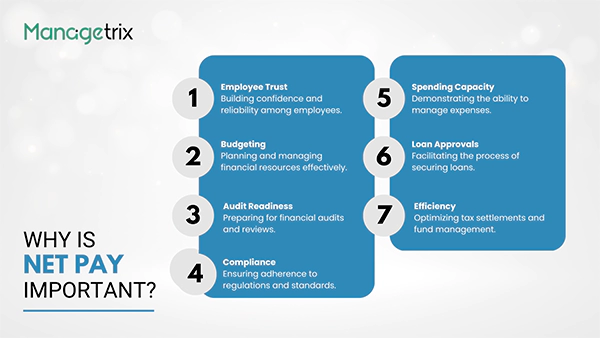
Understanding the net pay is significant to adhere to the legal framework, ensure audit readiness, enhance budgeting, and elevate employee trust and retention. Beyond that, learning other similar aspects is pivotal in comprehending the net payment definition.
- To Ensure Compliance: Learning net pay helps you ensure salary calculations follow tax laws and labor regulations. It minimizes legal risks by keeping payroll processes accurate and compliant with the prevailing legislation and regulations.
- Keep Records Audit Ready: Clear knowledge of net pay aids in maintaining correct payroll records, which ensures smooth audits and transparency in financial documentation.
- For Effective Budgeting: Knowing your net pay helps you plan and allocate your income wisely for the required resources and services. It allows you to have better control over your expenses and savings and manage financial goals.
- Strengthen Employee Trust: Transparent net pay calculations build confidence between the employer and employees. It shows fairness in pay distribution and enhances your workplace satisfaction.
- Shows Real Spending Capacity: When the taxes and deductions are reduced from the gross income, you arrive at the net income, which comes out as your in-hand salary.
- Effective in Loan Approvals: The loan approval process considers net income as the base of respective calculations in the process.
- Depicts Tax Efficiency: Considering net income helps you in adjusting tax settlements and managing the funds.
What Does a Decrease in Net Income Mean?
Net pay is reduced by deductions, which aim at providing multiple benefits, either from the side of the organization or the government. These deductions reduce your gross pay and make the figures for your net pay.
These deductions are classified into 2 major categories, which are mentioned below.
Obligatory Deductions
The obligatory tax deductions are mandatorily deducted, which your organization has to reduce from your gross salary. These deductions include:
- Income Tax: It is specified by the federal government and is rigidly based on the income levels of the employees.
- Wage Garnishments: These are the legally backed deductions withheld by the order of the court or any federal organization to pay off a debt.
- Social Security Tax: These taxes aim at funding the retirement, disability, or survivor’s benefits to employees.
- FICA Taxes: FICA stands for the Federal Insurance Contribution Act, which signifies the payroll tax for social security and Medicare schemes.
- State Income Taxes: Such taxes are imposed by the state governments and remain state-specific.
- Child Support Payments: These payments are the financial contribution to support one’s child after divorce.
Optional Deductions
Optional or voluntary deductions are not mandatorily reduced from the gross income. It stands at the discretion and requirement of the organization to deduct them. Some of its examples are:
- 401 (k) Contributions (for retirement plans)
- Life insurance
- Medical and health insurance
- Company merchandise purchases
- Charitable plans
These deductions may vary based on the country and state of operation of your firm, i.e., a European nation might have some different mandatory deductions, while Asian nations may have some others as per their prevailing corporate laws and regulations.
For example, in India, TDS, Employee Provident Fund, ESI, and professional tax are deducted from the gross salary to arrive at net pay.
Here, you need to understand pre-tax deduction as well. Pre-tax deductions are the deductions subtracted before the amount for tax and social security programs is made. They reduce your taxable income, thus increasing your net pay.
Conclusion
The above information would have addressed your core doubt, i.e, ‘what is net pay?’. It will help you manage their finances effectively, plan for expenses, and ensure salary transparency. By knowing the deductions involved and how net pay is calculated, you can better evaluate the compensation, stay compliant with tax obligations, and smartly make informed financial decisions.
Next Read: What is the VTO Meaning? (Voluntary Time Off)?
FAQs
1. What does net pay mean?
Ans: Net pay is the final in-hand payment that the employee receives after reducing all deductions and taxes from the gross pay.
2. What is the gross pay?
Ans: Gross pay is the salary the employee is entitled to receive before any deductions.
3. How to calculate net pay?
Ans: The net pay is calculated by subtracting the taxes and deductions from the gross pay, i.e., gross pay — deductions/taxes.
4. Why does my net pay fluctuate?
Ans: The net pay fluctuates due to changes in the taxes and deductions, especially the optional deductions that are subtracted from the gross pay.