

Well, paid time off is one of the best perks that a company offers to employees. So, whether you are an employer or a worker, you must figure out how does PTO accrual works and how is pto calculated.
Here, you can also discover the types of accrued leave, factors that affect it, and how companies benefit from the accrual rate. This article helps you to gain essential insights into how do you get PTO.
So, stay tuned!
Key Takeaways:
- An employee should earn accrued PTO first and use it later for illness, vacations, and family emergencies.
- Companies should follow state and local laws regarding PTO policy for the well-being of their workers.
- Factors like payouts, rollover, protected leave, probationary period, and negative PTO also affect the accruing time off.
You Must Know Before Moving Ahead:
What is a PTO?
PTO meaning stands for “paid time off,” which means that employees are paid for days or hours they aren’t working. It can be off for specific events, trips, sick days, and personal time.
What is a PTO Accrual?

PTO accrual is a process where employees need to earn paid time off gradually over time, rather than receiving a full lump sum upfront. It describes how you earn your paid time off.
Let’s understand with a real-time example! Suppose your company offers a per-day PTO when you work full-time for a month, it means that you should earn it first, then use it.
This helps employers or hiring managers manage costs and calculate the overall payroll of employees. For example, if you earn 5 days of PTO but never use them, your employer should pay you for these accrued PTO days, along with your salary. On the other hand, if you have no accrued paid time off, then you are only paid your salary.
How Does PTO Accrual Work?
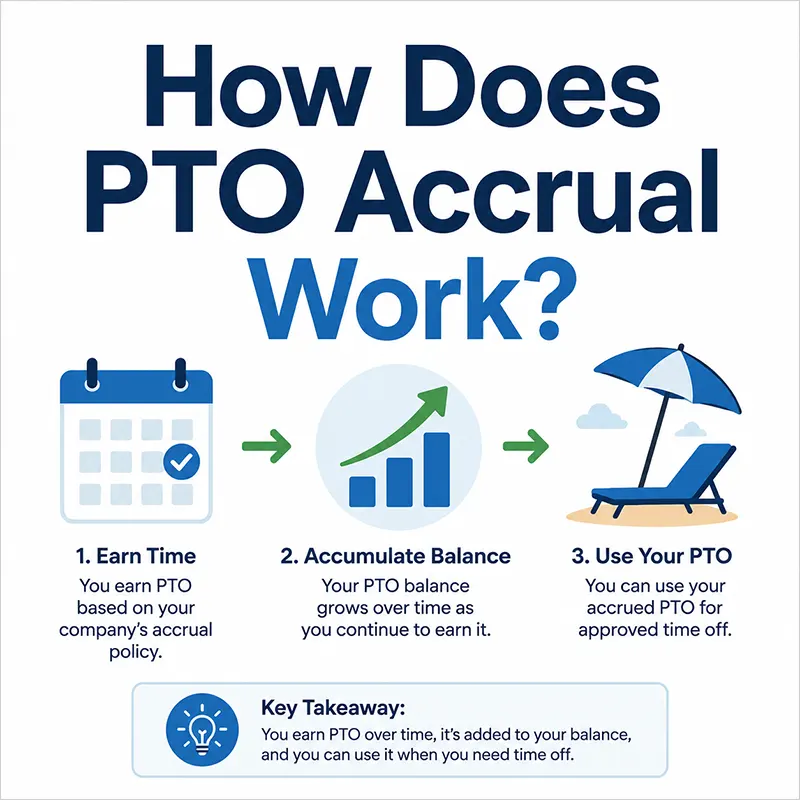
HR (Human Resources) in a company documented the official accrual rate and eligibility in the PTO policy. It includes time (hours, days, weeks, or months) and the pay period in brief detail for every worker.
So, you can understand the different ways a company implements offering PTO accrual.
1. Yearly Accrual or Annual Allotment
It is easy to use your PTO for a large vacation at the beginning of the year rather than waiting for last month if an organization offers an annual allotment front-loaded. But in the yearly accrual, you have to earn your PTO accrual hours or days over time.
2. Accrual Per Pay Period
Most companies use this method for both full-time and part-time employees. For example, you can earn your PTO hours based on the hours you work before, and later you can take leave. This can be financially risky for the employer in mid-term resignations.
How Can Employees Use PTO Accrual?
Earning PTO accrual doesn’t mean you can take leave anytime. Generally, employers don’t allow you to take PTO when the company needs you or during a workload.
You should request your leave schedule from your managers or seniors for approval. It helps you to manage your in-office work hand in hand without disrupting business operations.
According to the U.S. Bureau of Labor Statistics 2025 report, there are different PTO accrual rates between private industry and state and local government. It highlights that the accrued rate differs from industry to industry.
Pro Tip: If you request your PTO accrual long before your plans, you get an easy approval. But immediate leaves are always rejected by HR.
Types of PTO Accrual
Types of PTO accrual are accrual rates, accrual period, hours worked, PTO accrual on FMLA, PTO accrual on sick leave, and PTO accrual on disability leave.
Here, I’ve mentioned these types in great detail to help you.
1. Accrual Rates
Accrual rates mean the speed at which an employee gets paid time off for the actual number of hours they work. For example, “You have earned 0.05 hours a day,” or “You have 15 days of PTO when you work for a year.” It varies from the company’s policy. And always easy for employers and employees to calculate their paid time off.
2. Accrual Period
An accrual period is paid after each paycheck, which means that a worker earns time off weekly, bi-weekly, or monthly. For example, “When you get a biweekly paycheck in April 2026, you will use an accrued PTO in the third week of April 2026.”
3. Hours Worked
It is the actual amount of time an employee works in the office (40 hours a week). The hours-worked method is easy to calculate for employers and helps in offering a relevant salary.
Fact: New employees may not be immediately eligible for PTO accrual due to waiting periods or minimum-hours requirements.
4. PTO Accrual on FMLA
The Family and Medical Leave Act (FMLA) allows eligible employees to take unpaid leave except for PTO. But it solely depends on the employer’s policy on how does PTO accrued work or how do you get PTO during family medical conditions.
While some hiring managers want to take PTO along with FMLA leave, or some treat both of them as different leaves. Hence, it’s your responsibility to understand PTO policies before accepting your offer letter.
5. PTO Accrual on Sick Leave
In the United States, nearly 20 states require companies to offer paid leave on sick days. But there is no federal law on PTO accrual on sick leave. You have to read the policy to understand the rules and regulations of an organization.
It can affect how is PTO accrued if employers have different sick leave policies. But if the company follows state and local laws, you’ll get paid leave to recover from your illness.
6. PTO Accrual on Disability Leave
Similar to sick leave, state and local laws also mandate PTO accrual on disability leave. The policy may be different based on long-term and short-term disability.
In many cases, disability leave is paid under employees’ insurance or work-in-state. As I already informed you, each employer has a different policy for its workers.
Also Read: ASO Meaning: What Is Administrative Services Only in Insurance?
How Do You Calculate PTO Accrual?
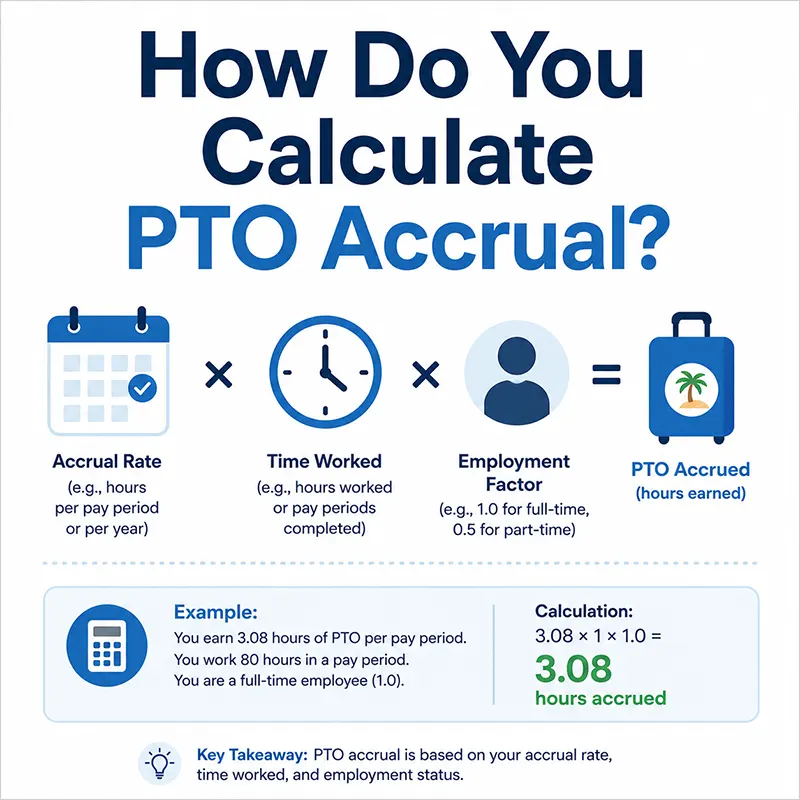
You can calculate PTO accrual through per-hour-worked, pay-per-period, front-loaded, full-time, part-time, tiered, and bonus methods.
Here are the following calculations with examples to help you understand how accrued PTO works.
1. Per-Hour-Worked Accrual
Salaried and hourly-based employees get an accrual per hour worked. The standard time is 40 hours a week.
For example, if an organization offers 12 days of PTO per year, you earn 0.04615 PTO hours.
Total PTO hours = 12 x 8 hours per day = 96 hours
Standard working hours = 40 hours x 52 weeks = 2,080 hours
Accrual Rate Formula = 96 PTO hours / 2,080 work hours = 0.04615
2. Per-Pay-Period Accrual
You can calculate the pay per period accrual as weekly, biweekly, semi-monthly, or monthly.
For example, you receive 15 days of PTO accrual per year in a biweekly pay period (26 pay periods per year).
Formula:
Accrual rate per pay period = Annual Benefit Amount / Total Pay Periods Per Year
Step 1: Convert days into hours = 15 x 8 hours per day = 120 hours
Step 2: Calculate per pay period = 120 / 26 = 4.62 hours per paycheck
3. Front-Loaded Accrual
Front-loaded accrual gives access to full paid time off at the beginning of the year (January 1). It ensures equality among new joiners and the existing employees.
For example, an employee gets 15 days of front-loaded accrual on January 1 and resigns on April 30.
Formula:
Prorated Earned PTO = Total Front-Loaded PTO x (Months Worked / Total Months in Year)
- Total front-loaded PTO = 15 days
- Months worked = 4 months
- Total months in a year = 12 months
Calculation: Earned PTO = 15 x (4 / 12) = 5 days
4. Full-Time and Part-Time PTO Accrual
Part-time employees can also earn paid leave like full-time workers. But the difference is that their standard time is not 40 hours per week.
For example, a company offers 15 days of PTO per year in a biweekly pay period.
PTO hours = 15 days (120 hours)
Pay frequency = 26 pay periods a year
- Full-time (40 hours per week)
120 hours / 26 pay periods = 4.62 hours per paycheck
- Part-time (20 hours per week)
Full-time equivalent ratio (FTE ratio) = 20 hours / 40 hours = 0.54.62 (full-time hours) x 0.5 (FTE ratio) = 2.31 hours per paycheck
5. Tiered PTO Accrual
Tiered PTO accrual is a reward for employees’ loyalty and designations. It means that old employees will have more PTO days than new joiners.
For example,
Tier 1 employee (new joinee)
80 hours of PTO accrual rate. (80 / 2080 = 0.0385 per hour)
Tier 2 employee (2 to 4 years of tenure)
120 hours of paid time off. (120 / 2080 = 0.0577 per hour)
Tier 3 employee (five or more years of tenure)
160 hours of accrued PTO. (160 / 2080 = 0.0769 per hour)
6. Bonus PTO
As the name suggests, employers reward a bonus of PTO to employees as an incentive when they achieve a target.
For example, your employer announced that if your team locks a $1 million deal with a specific client, you will be rewarded with an extra day of PTO accrual.
If your company offers 20 days of PTO, a bonus rate is an additional 5% of 20 days (20 x 5% = 1).
Also Read: 10 Best Reasons to Call Out of Work: Legitimate & Acceptable Situations
How Do Companies Benefit from PTO Accrual?
Companies can benefit from PTO accrual by offering work-life balance for employees, increasing job satisfaction and retention, supporting compliance with state and local laws, and helping in managing financial status.
Here are the following benefits for companies that offer PTO accrual.
1. Work-Life Balance for Employee
Accrued PTO helps employees to have a break from work pressure and enjoy their lives. It encourages them to spend quality time with their families, recharge their mental and physical health, and do their favorite hobbies. This reduces stress and increases productivity in the workplace.
2. Increase Job Satisfaction and Retention
Employees generally prefer to stay in a company that gives importance to work-life balance and personal needs. A good PTO accrual rate satisfies them and reduces the overall cost of hiring new workers. Thus, it also helps in financial stability.
3. Supports Compliance with State and Local Laws
State laws in California must ensure rules regarding the minimum accrual rate, vacation days, and tenure period. This may affect a company’s PTO accrual policy. That’s why it’s better to comply with local and state laws to avoid penalties.
4. Helps in Managing Financial Status
Employers can manage the paid time off budget before spreading it over the whole year for financial planning. For employees, it helps in planning their vacations or sick leave for the year and tracking accrued hours.
5 Important Factors to Implement PTO Accrual
The 5 important factors are PTO payouts, protected leave, probationary period, accrual rollover, and negative balances, which should be considered before implementation of accrual.
Let’s have a look at these factors to understand how does PTO accrued works.
1. PTO Payouts
PTO payouts mean that employers should pay the unused paid time off to their employees. For example, if you have 4 unused accrued days, your company will pay an additional amount of 4 PTO days along with your salary.
2. Protected Leave
Protected leave is protected under federal and state laws. Companies should offer a minimum paid time off to employees for specific purposes, such as health coverage and family vacations. It helps workers to take a protected leave without fear of termination.
3. Probationary Period
“Probationary period” refers to the initial trial phase of a new job. Employers enforce a 90-day or 3-month probationary period to restrict new employees from using paid time off. It helps organizations to protect PTO before they’ve proven the right fit for the job.
4. Accrual Rollover
Accrual rollover is the policy where employees are allowed to transfer their unused PTO to another calendar year. But many companies put restrictions and introduce limited rollover. For example, if you have 15 days of PTO, you’re only allowed to transfer 5 days to the next year.
5. Negative Balances
Negative PTO is a situation in which workers use more time off than their accrued leave. For example, if an employee asks for more paid leave than they have earned, an employer should transfer them to negative PTO. But this condition is only eligible for emergencies such as illness or bereavement.
Wrapping Up!
Now, you understand that the PTO accrual rate is not just a policy; it’s an employee’s right to their well-being. It helps both employers and workers to manage a financial budget and plan leaves throughout the year.
As an employer, it must be difficult to calculate PTO accrual, attendance, and track time for laborers; that’s why you must use the advanced Managetric feature for automated work.
Frequently Asked Questions
1. What is a good PTO rate?
Ans: A good PTO rate is 15 to 20 days per year in a company. There is no legal consideration or law, so it may be different in other organizations.
2. How many days is 40 hours of PTO?
Ans: 40 hours of PTO is 5 business days (Monday to Friday).
3. Is it better to get paid PTO or use it?
Ans: Personally, I feel that you should use paid time off for medical emergencies, long vacations, or enjoying your personal life.
4. Is 20 days of PTO a lot for an employee?
Ans: Yes, 20 days of paid time off is enough for an employee who works 8 hours a day.
- Human Resources Unit – Accrued Leave – CT Department of Labor
- Unlimited Paid Time Off Policies: Unlocking the Best and Unleashing the Beast – National Library of Medicine